
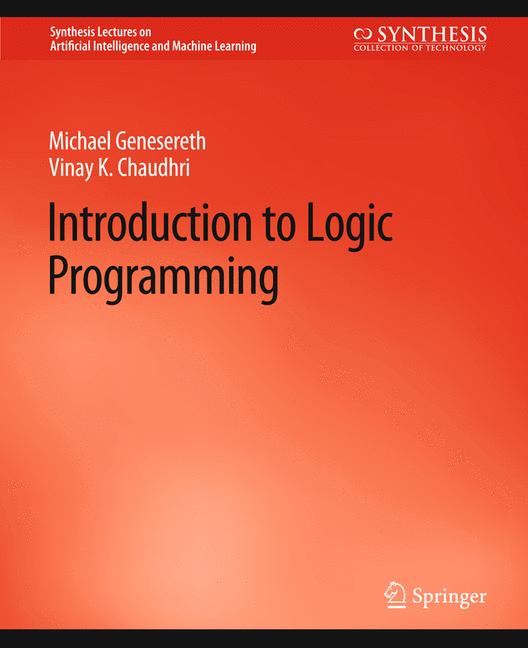
Introduction to Logic Programming
☆☆☆☆☆
(0 opinii)
Najniższa cena (z dostawą)
39,55 EUR
Typowa cena36,29 PLN
Najniższa (90 dni)35,20 PLN
Liczba ofert2
Ostatnia aktualizacja4 dni temu
| Sprzedawca | Cena produktu | Dostawa | Razem | Dostępność | Aktualizacja | |
|---|---|---|---|---|---|---|
| SP SpringerNatureLink Shop INT | 39,55 EUR | 0 zł | 39,55 EUR | Dostępny | 4 dni temu | Zobacz ofertę |
| SP Springer Nature Author | 39,55 EUR | 29,00 EUR | 68,55 EUR | Dostępny | 4 dni temu | Zobacz ofertę |
Ceny i dostępność mogą ulec zmianie. Ostatnia aktualizacja: 08.08.2026 20:41.
EAN
9783031015861
Springer Nature
0,0
☆☆☆☆☆
0 opinii
5★
0%
4★
0%
3★
0%
2★
0%
1★
0%
Opinie o produkcie
Brak opinii — bądź pierwszy!
Logic Programming is a style of programming in which programs take the form of sets of sentences in the language of Symbolic Logic. Over the years, there has been growing interest in Logic Programming due to applications in deductive databases, automated worksheets, Enterprise Management (business rules), Computational Law, and General Game Playing. This book introduces Logic Programming theory, current technology, and popular applications. In this volume, we take an innovative, model-theoretic approach to logic programming. We begin with the fundamental notion of datasets, i.e., sets of ground atoms. Given this fundamental notion, we introduce views, i.e., virtual relations; and we define classical logic programs as sets of view definitions, written using traditional Prolog-like notation but with semantics given in terms of datasets rather than implementation. We then introduce actions, i.e., additions and deletions of ground atoms; and we define dynamic logic programs as sets of action definitions. In addition to the printed book, there is an online version of the text with an interpreter and a compiler for the language used in the text and an integrated development environment for use in developing and deploying practical logic programs.
Podobne produkty
 Patient Safety Coaching
od $91.97
Patient Safety Coaching
od $91.97
 Ethnography and Diversity
od $69.30
Ethnography and Diversity
od $69.30
 Smart Villages
od $91.97
Smart Villages
od $91.97
 Nuclear Non-Proliferation in International Law - Volume VI
od $91.97
Nuclear Non-Proliferation in International Law - Volume VI
od $91.97
 The Price of Freedom
od $91.97
The Price of Freedom
od $91.97
 Eco-Social Policy in the OECD and the World Bank
od $91.97
Eco-Social Policy in the OECD and the World Bank
od $91.97
 Special Topics in Policing
od $122.58
Special Topics in Policing
od $122.58
 Music from the Heart
od $91.97
Music from the Heart
od $91.97