
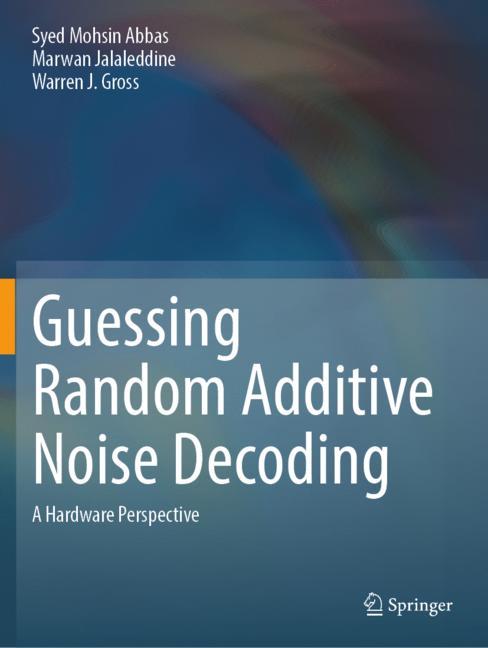
Guessing Random Additive Noise Decoding
☆☆☆☆☆
(0 opinii)
Najniższa cena (z dostawą)
98,99 GBP
Typowa cena3 112,48 PLN
Najniższa (90 dni)89,87 PLN
Liczba ofert2
Ostatnia aktualizacja4 dni temu
| Sprzedawca | Cena produktu | Dostawa | Razem | Dostępność | Aktualizacja | |
|---|---|---|---|---|---|---|
| SP SpringerNatureLink Shop INT | 69,99 GBP | 29,00 GBP | 98,99 GBP | Dostępny | 4 dni temu | Zobacz ofertę |
| SP Springer Nature Author | 21 449,00 JPY | 0 zł | 21 449,00 JPY | Dostępny | 4 dni temu | Zobacz ofertę |
Ceny i dostępność mogą ulec zmianie. Ostatnia aktualizacja: 08.08.2026 22:40.
0,0
☆☆☆☆☆
0 opinii
5★
0%
4★
0%
3★
0%
2★
0%
1★
0%
Opinie o produkcie
Brak opinii — bądź pierwszy!
This book gives a detailed overview of a universal Maximum Likelihood (ML) decoding technique, known as Guessing Random Additive Noise Decoding (GRAND), has been introduced for short-length and high-rate linear block codes. The interest in short channel codes and the corresponding ML decoding algorithms has recently been reignited in both industry and academia due to emergence of applications with strict reliability and ultra-low latency requirements . A few of these applications include Machine-to-Machine (M2M) communication, augmented and virtual Reality, Intelligent Transportation Systems (ITS), the Internet of Things (IoTs), and Ultra-Reliable and Low Latency Communications (URLLC), which is an important use case for the 5G-NR standard. GRAND features both soft-input and hard-input variants. Moreover, there are traditional GRAND variants that can be used with any communication channel, and specialized GRAND variants that are developed for a specific communication channel. This book presents a detailed overview of these GRAND variants and their hardware architectures. The book is structured into four parts. Part 1 introduces linear block codes and the GRAND algorithm. Part 2 discusses the hardware architecture for traditional GRAND variants that can be applied to any underlying communication channel. Part 3 describes the hardware architectures for specialized GRAND variants developed for specific communication channels. Lastly, Part 4 provides an overview of recently proposed GRAND variants and their unique applications. This book is ideal for researchers or engineers looking to implement high-throughput and energy-efficient hardware for GRAND, as well as seasoned academics and graduate students interested in the topic of VLSI hardware architectures. Additionally, it can serve as reading material in graduate courses covering modern error correcting codes and Maximum Likelihood decoding for short codes.
Podobne produkty
 Patient Safety Coaching
od $91.97
Patient Safety Coaching
od $91.97
 Ethnography and Diversity
od $69.30
Ethnography and Diversity
od $69.30
 Smart Villages
od $91.97
Smart Villages
od $91.97
 Nuclear Non-Proliferation in International Law - Volume VI
od $91.97
Nuclear Non-Proliferation in International Law - Volume VI
od $91.97
 The Price of Freedom
od $91.97
The Price of Freedom
od $91.97
 Eco-Social Policy in the OECD and the World Bank
od $91.97
Eco-Social Policy in the OECD and the World Bank
od $91.97
 Special Topics in Policing
od $122.58
Special Topics in Policing
od $122.58
 Music from the Heart
od $91.97
Music from the Heart
od $91.97