
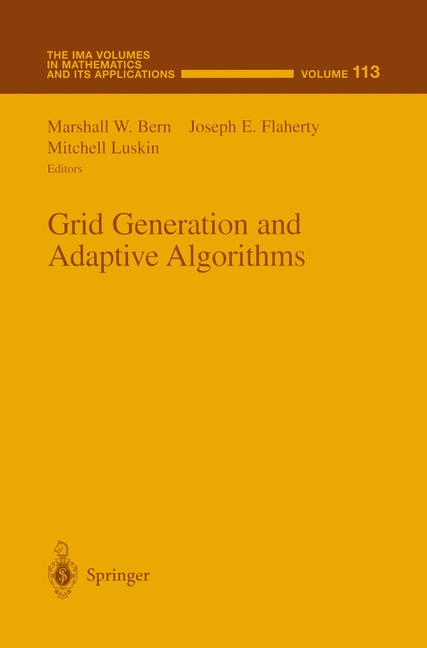
Grid Generation and Adaptive Algorithms
☆☆☆☆☆
(0 opinii)
Najniższa cena (z dostawą)
7 174,00 JPY
Typowa cena491,72 PLN
Najniższa (90 dni)44,99 PLN
Liczba ofert6
Ostatnia aktualizacja1 tydzień temu
Historia ceny (90 dni)
Pełna historia
2026-08-08
2026-08-15
| Zaktualizowano | Cena |
|---|---|
| 2026-08-08 | 49,99 |
| 2026-08-14 | 44,99 |
| 2026-08-15 | 51,99 |
| Sprzedawca | Cena produktu | Dostawa | Razem | Dostępność | Aktualizacja | |
|---|---|---|---|---|---|---|
| SP SpringerNatureLink Shop INT | 7 149,00 JPY | 25,00 JPY | 7 174,00 JPY | Dostępny | 5 dni temu | Zobacz ofertę |
| SP Springer Nature Author | 7 149,00 JPY | 15,00 JPY | 7 164,00 JPY | Dostępny | 1 tydzień temu | Zobacz ofertę |
| SP SpringerNatureLink Shop INT | 49,99 USD | 0 zł | 49,99 USD | Dostępny | 5 dni temu | Zobacz ofertę |
| SP SpringerNatureLink Shop INT | 54,99 USD | 0 zł | 54,99 USD | Dostępny | 5 dni temu | Zobacz ofertę |
| SP SpringerNatureLink Shop INT | 54,99 USD | 25,00 USD | 79,99 USD | Dostępny | 5 dni temu | Zobacz ofertę |
| SP SpringerNatureLink Shop INT | 59,00 EUR | 29,00 EUR | 88,00 EUR | Dostępny | 5 dni temu | Zobacz ofertę |
Ceny i dostępność mogą ulec zmianie. Ostatnia aktualizacja: 08.08.2026 23:12.
0,0
☆☆☆☆☆
0 opinii
5★
0%
4★
0%
3★
0%
2★
0%
1★
0%
Opinie o produkcie
Brak opinii — bądź pierwszy!
This IMA Volume in Mathematics and its Applications GRID GENERATION AND ADAPTIVE ALGORITHMS is based on the proceedings of a workshop with the same title. The work shop was an integral part of the 1996-97 IMA program on "MATHEMAT ICS IN HIGH-PERFORMANCE COMPUTING. " I would like to thank Marshall Bern (Xerox, Palo Alto Research Cen ter), Joseph E. Flaherty (Department of Computer Science, Rensselaer Polytechnic Institute), and Mitchell Luskin (School of Mathematics, Uni versity of Minnesota), for their excellent work as organizers of the meeting and for editing the proceedings. I also take this opportunity to thank the National Science Founda tion (NSF), Department of Energy (DOE), and the Army Research Office (ARO), whose financial support made the workshop possible. Willard Miller, Jr. , Professor and Director v PREFACE Scientific and engineering computation has become so complex that traditional numerical computation on uniform meshes is generally not pos sible or too expensive. Mesh generation must reflect both the domain geometry and the expected solution characteristics. Meshes should, fur thermore, be related to the solution through computable estimates of dis cretization errors. This, suggests an automatic and adaptive process where an initial mesh is enriched with the goal of computing a solution with prescribed accuracy specifications in an optimal manner. While automatic mesh generation procedures and adaptive strategies are becoming available, major computational challenges remain. Three-dimensional mesh genera tion is still far from automatic.
Podobne produkty
 50 Years of Philosophy and Medicine
od $107.30
50 Years of Philosophy and Medicine
od $107.30
 Understanding Cybersecurity Law and Digital Privacy
od $122.63
Understanding Cybersecurity Law and Digital Privacy
od $122.63
 Decisions in International Trade and Logistics
od $122.63
Decisions in International Trade and Logistics
od $122.63
 Advances in Economic Measurement
od $122.63
Advances in Economic Measurement
od $122.63
 Nanomaterials
od $137.96
Nanomaterials
od $137.96
 Sustainable Scaffolds-based Strategies in Tissue Engineering and Regenerative Medicine
od $162.87
Sustainable Scaffolds-based Strategies in Tissue Engineering and Regenerative Medicine
od $162.87
 Narratives in Educational Research
od $162.87
Narratives in Educational Research
od $162.87
 Environmental Biology of the Young Chinese Sturgeon
od $210.78
Environmental Biology of the Young Chinese Sturgeon
od $210.78