
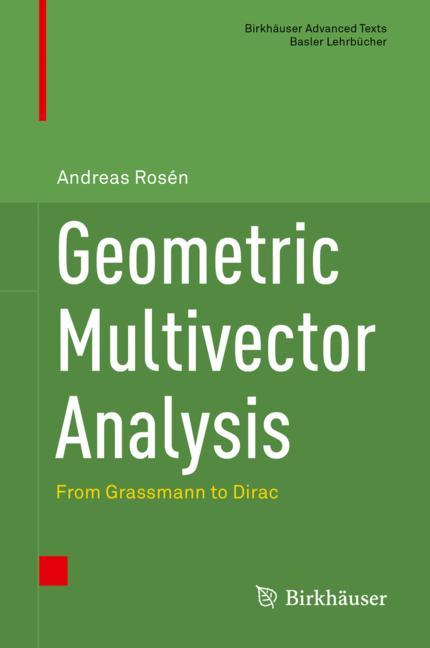
Geometric Multivector Analysis
☆☆☆☆☆
(0 opinii)
Najniższa cena (z dostawą)
68,05 EUR
Liczba ofert3
Ostatnia aktualizacja3 dni temu
| Sprzedawca | Cena produktu | Dostawa | Razem | Dostępność | Aktualizacja | |
|---|---|---|---|---|---|---|
| SP SpringerNatureLink Shop INT | 43,05 EUR | 25,00 EUR | 68,05 EUR | Dostępny | 3 dni temu | Zobacz ofertę |
| SP Springer Nature Author | 43,05 EUR | 29,00 EUR | 72,05 EUR | Dostępny | 1 tydzień temu | Zobacz ofertę |
| SP SpringerNatureLink Shop INT | 7 435,00 JPY | 15,00 JPY | 7 450,00 JPY | Dostępny | 3 dni temu | Zobacz ofertę |
Ceny i dostępność mogą ulec zmianie. Ostatnia aktualizacja: 15.08.2026 07:52.
EAN
9783030314118
Springer Nature
0,0
☆☆☆☆☆
0 opinii
5★
0%
4★
0%
3★
0%
2★
0%
1★
0%
Opinie o produkcie
Brak opinii — bądź pierwszy!
This book presents a step-by-step guide to the basic theory of multivectors and spinors, with a focus on conveying to the reader the geometric understanding of these abstract objects. Following in the footsteps of M. Riesz and L. Ahlfors, the book also explains how Clifford algebra offers the ideal tool for studying spacetime isometries and Möbius maps in arbitrary dimensions. The book carefully develops the basic calculus of multivector fields and differential forms, and highlights novelties in the treatment of, e.g., pullbacks and Stokes’s theorem as compared to standard literature. It touches on recent research areas in analysis and explains how the function spaces of multivector fields are split into complementary subspaces by the natural first-order differential operators, e.g., Hodge splittings and Hardy splittings. Much of the analysis is done on bounded domains in Euclidean space, with a focus on analysis at the boundary. The book also includes a derivation of new Dirac integral equations for solving Maxwell scattering problems, which hold promise for future numerical applications. The last section presents down-to-earth proofs of index theorems for Dirac operators on compact manifolds, one of the most celebrated achievements of 20th-century mathematics. The book is primarily intended for graduate and PhD students of mathematics. It is also recommended for more advanced undergraduate students, as well as researchers in mathematics interested in an introduction to geometric analysis.
Podobne produkty
 50 Years of Philosophy and Medicine
od $107.30
50 Years of Philosophy and Medicine
od $107.30
 Understanding Cybersecurity Law and Digital Privacy
od $122.63
Understanding Cybersecurity Law and Digital Privacy
od $122.63
 Decisions in International Trade and Logistics
od $122.63
Decisions in International Trade and Logistics
od $122.63
 Advances in Economic Measurement
od $122.63
Advances in Economic Measurement
od $122.63
 Nanomaterials
od $137.96
Nanomaterials
od $137.96
 Sustainable Scaffolds-based Strategies in Tissue Engineering and Regenerative Medicine
od $162.87
Sustainable Scaffolds-based Strategies in Tissue Engineering and Regenerative Medicine
od $162.87
 Narratives in Educational Research
od $162.87
Narratives in Educational Research
od $162.87
 Environmental Biology of the Young Chinese Sturgeon
od $210.78
Environmental Biology of the Young Chinese Sturgeon
od $210.78