
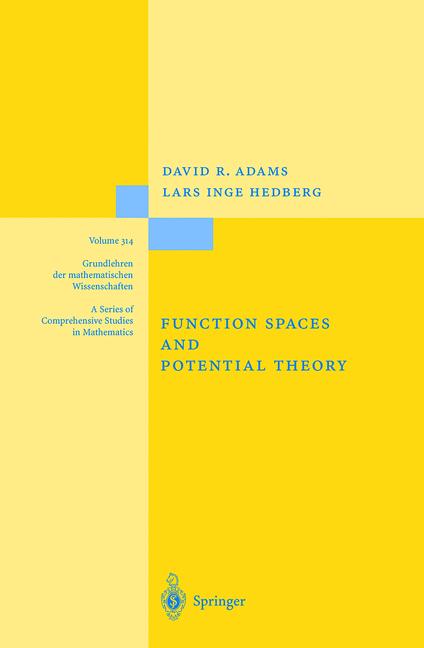
Function Spaces and Potential Theory
☆☆☆☆☆
(0 opinii)
Najniższa cena (z dostawą)
20 019,00 JPY
Typowa cena2 673,32 PLN
Najniższa (90 dni)119,99 PLN
Liczba ofert6
Ostatnia aktualizacja1 tydzień temu
Historia ceny (90 dni)
Pełna historia
2026-08-08
2026-08-15
| Zaktualizowano | Cena |
|---|---|
| 2026-08-08 | 119,99 |
| 2026-08-15 | 145,59 |
| Sprzedawca | Cena produktu | Dostawa | Razem | Dostępność | Aktualizacja | |
|---|---|---|---|---|---|---|
| SP SpringerNatureLink Shop INT | 20 019,00 JPY | 0 zł | 20 019,00 JPY | Dostępny | 1 tydzień temu | Zobacz ofertę |
| SP Springer Nature Author | 20 019,00 JPY | 25,00 JPY | 20 044,00 JPY | Dostępny | 1 tydzień temu | Zobacz ofertę |
| SP SpringerNatureLink Shop INT | 139,99 USD | 0 zł | 139,99 USD | Dostępny | 1 tydzień temu | Zobacz ofertę |
| SP SpringerNatureLink Shop INT | 159,99 USD | 0 zł | 159,99 USD | Dostępny | 1 tydzień temu | Zobacz ofertę |
| SP SpringerNatureLink Shop INT | 159,99 USD | 0 zł | 159,99 USD | Dostępny | 1 tydzień temu | Zobacz ofertę |
| SP SpringerNatureLink Shop INT | 165,50 EUR | 25,00 EUR | 190,50 EUR | Dostępny | 1 tydzień temu | Zobacz ofertę |
Ceny i dostępność mogą ulec zmianie. Ostatnia aktualizacja: 08.08.2026 23:32.
0,0
☆☆☆☆☆
0 opinii
5★
0%
4★
0%
3★
0%
2★
0%
1★
0%
Opinie o produkcie
Brak opinii — bądź pierwszy!
Function spaces, especially those spaces that have become known as Sobolev spaces, and their natural extensions, are now a central concept in analysis. In particular, they play a decisive role in the modem theory of partial differential equations (PDE). Potential theory, which grew out of the theory of the electrostatic or gravita tional potential, the Laplace equation, the Dirichlet problem, etc. , had a fundamen tal role in the development of functional analysis and the theory of Hilbert space. Later, potential theory was strongly influenced by functional analysis. More re cently, ideas from potential theory have enriched the theory of those more general function spaces that appear naturally in the study of nonlinear partial differential equations. This book is motivated by the latter development. The connection between potential theory and the theory of Hilbert spaces can be traced back to C. F. Gauss [181], who proved (with modem rigor supplied almost a century later by O. Frostman [158]) the existence of equilibrium potentials by minimizing a quadratic integral, the energy. This theme is pervasive in the work of such mathematicians as D. Hilbert, Ch. -J. de La Vallee Poussin, M. Riesz, O. Frostman, A. Beurling, and the connection was made particularly clear in the work of H. Cartan [97] in the 1940's. In the thesis of J. Deny [119], and in the subsequent work of J. Deny and J. L.
Podobne produkty
 50 Years of Philosophy and Medicine
od $107.30
50 Years of Philosophy and Medicine
od $107.30
 Understanding Cybersecurity Law and Digital Privacy
od $122.63
Understanding Cybersecurity Law and Digital Privacy
od $122.63
 Decisions in International Trade and Logistics
od $122.63
Decisions in International Trade and Logistics
od $122.63
 Advances in Economic Measurement
od $122.63
Advances in Economic Measurement
od $122.63
 Nanomaterials
od $137.96
Nanomaterials
od $137.96
 Sustainable Scaffolds-based Strategies in Tissue Engineering and Regenerative Medicine
od $162.87
Sustainable Scaffolds-based Strategies in Tissue Engineering and Regenerative Medicine
od $162.87
 Narratives in Educational Research
od $162.87
Narratives in Educational Research
od $162.87
 Environmental Biology of the Young Chinese Sturgeon
od $210.78
Environmental Biology of the Young Chinese Sturgeon
od $210.78