
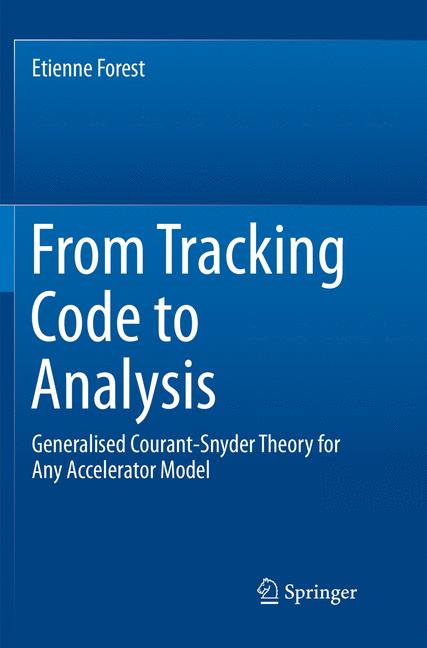
From Tracking Code to Analysis
☆☆☆☆☆
(0 opinii)
Najniższa cena (z dostawą)
14 328,00 JPY
Typowa cena658,93 PLN
Najniższa (90 dni)84,99 PLN
Liczba ofert2
Ostatnia aktualizacja21 godzin temu
| Sprzedawca | Cena produktu | Dostawa | Razem | Dostępność | Aktualizacja | |
|---|---|---|---|---|---|---|
| SP Springer Nature Author | 14 299,00 JPY | 29,00 JPY | 14 328,00 JPY | Dostępny | 21 godzin temu | Zobacz ofertę |
| SP SpringerNatureLink Shop INT | 109,99 USD | 29,00 USD | 138,99 USD | Dostępny | 1 dzień temu | Zobacz ofertę |
Ceny i dostępność mogą ulec zmianie. Ostatnia aktualizacja: 08.08.2026 23:21.
0,0
☆☆☆☆☆
0 opinii
5★
0%
4★
0%
3★
0%
2★
0%
1★
0%
Opinie o produkcie
Brak opinii — bądź pierwszy!
This book illustrates a theory well suited to tracking codes, which the author has developed over the years. Tracking codes now play a central role in the design and operation of particle accelerators. The theory is fully explained step by step with equations and actual codes that the reader can compile and run with freely available compilers. In this book, the author pursues a detailed approach based on finite “s”-maps, since this is more natural as long as tracking codes remain at the centre of accelerator design. The hierarchical nature of software imposes a hierarchy that puts map-based perturbation theory above any other methods. The map-based approach, perhaps paradoxically, allows ultimately an implementation of the Deprit-Guignard-Schoch algorithms more faithful than anything found in the standard literature. This hierarchy of methods is not a personal choice: it follows logically from tracking codes overloaded with a truncated power series algebra package. After defining abstractly and briefly what a tracking code is, the author illustrates most of the accelerator perturbation theory using an actual code: PTC. This book may seem like a manual for PTC; however, the reader is encouraged to explore other tools as well. The presence of an actual code ensures that readers will have a tool with which they can test their understanding. Codes and examples will be available from various sites since PTC is in MAD-X (CERN) and BMAD (Cornell).
Podobne produkty
 Patient Safety Coaching
od $91.97
Patient Safety Coaching
od $91.97
 Ethnography and Diversity
od $69.30
Ethnography and Diversity
od $69.30
 Smart Villages
od $91.97
Smart Villages
od $91.97
 Nuclear Non-Proliferation in International Law - Volume VI
od $91.97
Nuclear Non-Proliferation in International Law - Volume VI
od $91.97
 The Price of Freedom
od $91.97
The Price of Freedom
od $91.97
 Eco-Social Policy in the OECD and the World Bank
od $91.97
Eco-Social Policy in the OECD and the World Bank
od $91.97
 Special Topics in Policing
od $122.58
Special Topics in Policing
od $122.58
 Music from the Heart
od $91.97
Music from the Heart
od $91.97