
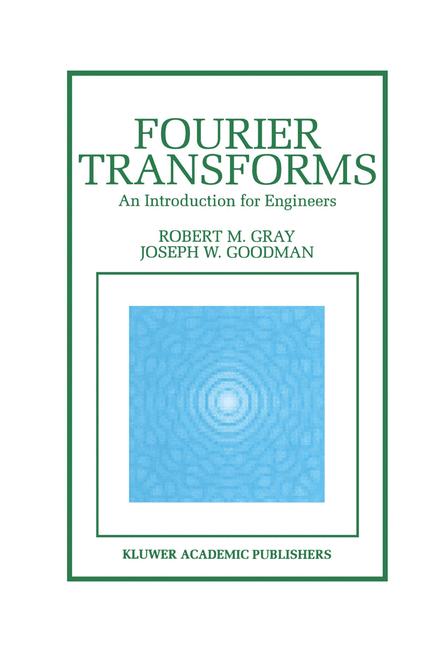
Fourier Transforms
☆☆☆☆☆
(0 opinii)
Najniższa cena (z dostawą)
17 174,00 JPY
Typowa cena2 196,88 PLN
Najniższa (90 dni)109,99 PLN
Liczba ofert6
Ostatnia aktualizacja1 tydzień temu
Historia ceny (90 dni)
Pełna historia
2026-08-08
2026-08-15
| Zaktualizowano | Cena |
|---|---|
| 2026-08-08 | 109,99 |
| 2026-08-15 | 124,79 |
| Sprzedawca | Cena produktu | Dostawa | Razem | Dostępność | Aktualizacja | |
|---|---|---|---|---|---|---|
| SP SpringerNatureLink Shop INT | 17 159,00 JPY | 15,00 JPY | 17 174,00 JPY | Dostępny | 4 dni temu | Zobacz ofertę |
| SP Springer Nature Author | 17 159,00 JPY | 19,00 JPY | 17 178,00 JPY | Dostępny | 1 tydzień temu | Zobacz ofertę |
| SP SpringerNatureLink Shop INT | 119,99 USD | 29,00 USD | 148,99 USD | Dostępny | 4 dni temu | Zobacz ofertę |
| SP SpringerNatureLink Shop INT | 129,99 USD | 19,00 USD | 148,99 USD | Dostępny | 4 dni temu | Zobacz ofertę |
| SP SpringerNatureLink Shop INT | 129,99 USD | 15,00 USD | 144,99 USD | Dostępny | 4 dni temu | Zobacz ofertę |
| SP SpringerNatureLink Shop INT | 142,00 EUR | 15,00 EUR | 157,00 EUR | Dostępny | 4 dni temu | Zobacz ofertę |
Ceny i dostępność mogą ulec zmianie. Ostatnia aktualizacja: 08.08.2026 23:27.
0,0
☆☆☆☆☆
0 opinii
5★
0%
4★
0%
3★
0%
2★
0%
1★
0%
Opinie o produkcie
Brak opinii — bądź pierwszy!
The Fourier transform is one of the most important mathematical tools in a wide variety of fields in science and engineering. In the abstract it can be viewed as the transformation of a signal in one domain (typically time or space) into another domain, the frequency domain. Applications of Fourier transforms, often called Fourier analysis or harmonic analysis, provide useful decompositions of signals into fundamental or "primitive" components, provide shortcuts to the computation of complicated sums and integrals, and often reveal hidden structure in data. Fourier analysis lies at the base of many theories of science and plays a fundamental role in practical engineering design. The origins of Fourier analysis in science can be found in Ptolemy's decomposing celestial orbits into cycles and epicycles and Pythagorus' de composing music into consonances. Its modern history began with the eighteenth century work of Bernoulli, Euler, and Gauss on what later came to be known as Fourier series. J. Fourier in his 1822 Theorie analytique de la Chaleur [16] (still available as a Dover reprint) was the first to claim that arbitrary periodic functions could be expanded in a trigonometric (later called a Fourier) series, a claim that was eventually shown to be incorrect, although not too far from the truth. It is an amusing historical sidelight that this work won a prize from the French Academy, in spite of serious concerns expressed by the judges (Laplace, Lagrange, and Legendre) re garding Fourier's lack of rigor.
Podobne produkty
 50 Years of Philosophy and Medicine
od $107.30
50 Years of Philosophy and Medicine
od $107.30
 Understanding Cybersecurity Law and Digital Privacy
od $122.63
Understanding Cybersecurity Law and Digital Privacy
od $122.63
 Decisions in International Trade and Logistics
od $122.63
Decisions in International Trade and Logistics
od $122.63
 Advances in Economic Measurement
od $122.63
Advances in Economic Measurement
od $122.63
 Nanomaterials
od $137.96
Nanomaterials
od $137.96
 Sustainable Scaffolds-based Strategies in Tissue Engineering and Regenerative Medicine
od $162.87
Sustainable Scaffolds-based Strategies in Tissue Engineering and Regenerative Medicine
od $162.87
 Narratives in Educational Research
od $162.87
Narratives in Educational Research
od $162.87
 Environmental Biology of the Young Chinese Sturgeon
od $210.78
Environmental Biology of the Young Chinese Sturgeon
od $210.78