
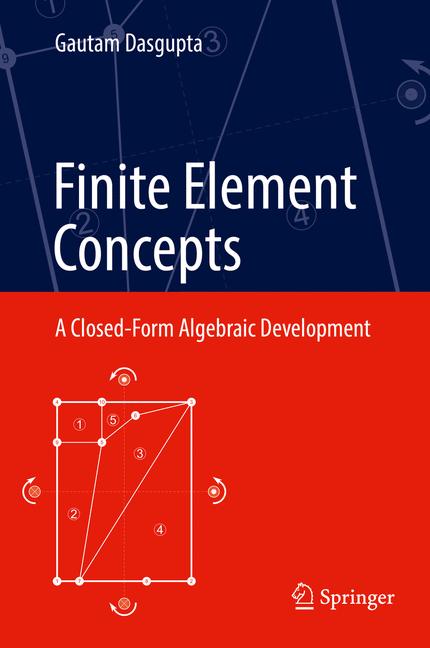
Finite Element Concepts
☆☆☆☆☆
(0 opinii)
Najniższa cena (z dostawą)
12 888,00 JPY
Typowa cena681,49 PLN
Najniższa (90 dni)94,94 PLN
Liczba ofert3
Ostatnia aktualizacja1 tydzień temu
Historia ceny (90 dni)
Pełna historia
2026-08-08
2026-08-15
| Zaktualizowano | Cena |
|---|---|
| 2026-08-08 | 94,94 |
| 2026-08-15 | 94,94 |
| Sprzedawca | Cena produktu | Dostawa | Razem | Dostępność | Aktualizacja | |
|---|---|---|---|---|---|---|
| SP Springer Nature Author | 12 869,00 JPY | 19,00 JPY | 12 888,00 JPY | Dostępny | 1 tydzień temu | Zobacz ofertę |
| SP SpringerNatureLink Shop INT | 98,09 EUR | 19,00 EUR | 117,09 EUR | Dostępny | 5 dni temu | Zobacz ofertę |
| VI VitalSource | 506,62 ZAR | 19,00 ZAR | 525,62 ZAR | Dostępny | 1 tydzień temu | Zobacz ofertę |
Ceny i dostępność mogą ulec zmianie. Ostatnia aktualizacja: 08.08.2026 06:09.
EAN
9781493974214
Springer Nature
0,0
☆☆☆☆☆
0 opinii
5★
0%
4★
0%
3★
0%
2★
0%
1★
0%
Opinie o produkcie
Brak opinii — bądź pierwszy!
This text presents a highly original treatment of the fundamentals of FEM, developed using computer algebra, based on undergraduate-level engineering mathematics and the mechanics of solids. The book is divided into two distinct parts of nine chapters and seven appendices. The first chapter reviews the energy concepts in structural mechanics with bar problems, which is continued in the next chapter for truss analysis using Mathematica programs. The Courant and Clough triangular elements for scalar potentials and linear elasticity are covered in chapters three and four, followed by four-node elements. Chapters five and six describe Taig’s isoparametric interpolants and Iron’s patch test. Rayleigh vector modes, which satisfy point-wise equilibrium, are elaborated on in chapter seven along with successful patch tests in the physical (x,y) Cartesian frame. Chapter eight explains point-wise incompressibility and employs (Moore-Penrose) inversion of rectangular matrices. The finalchapter analyzes patch-tests in all directions and introduces five-node elements for linear stresses. Curved boundaries and higher order stresses are addressed in closed algebraic form. Appendices give a short introduction to Mathematica, followed by truss analysis using symbolic codes that could be used in all FEM problems to assemble element matrices and solve for all unknowns. All Mathematica codes for theoretical formulations and graphics are included with extensive numerical examples.
Podobne produkty
 50 Years of Philosophy and Medicine
od $107.30
50 Years of Philosophy and Medicine
od $107.30
 Understanding Cybersecurity Law and Digital Privacy
od $122.63
Understanding Cybersecurity Law and Digital Privacy
od $122.63
 Decisions in International Trade and Logistics
od $122.63
Decisions in International Trade and Logistics
od $122.63
 Advances in Economic Measurement
od $122.63
Advances in Economic Measurement
od $122.63
 Nanomaterials
od $137.96
Nanomaterials
od $137.96
 Sustainable Scaffolds-based Strategies in Tissue Engineering and Regenerative Medicine
od $162.87
Sustainable Scaffolds-based Strategies in Tissue Engineering and Regenerative Medicine
od $162.87
 Narratives in Educational Research
od $162.87
Narratives in Educational Research
od $162.87
 Environmental Biology of the Young Chinese Sturgeon
od $210.78
Environmental Biology of the Young Chinese Sturgeon
od $210.78