
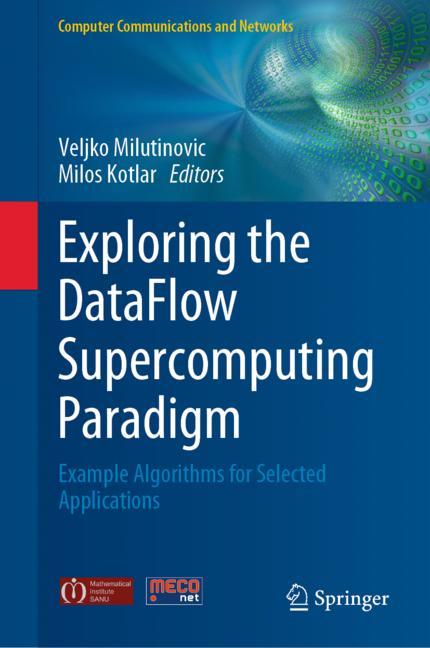
Exploring the DataFlow Supercomputing Paradigm
☆☆☆☆☆
(0 opinii)
Najniższa cena (z dostawą)
52,01 AUD
Typowa cena657,56 PLN
Najniższa (90 dni)27,01 PLN
Liczba ofert3
Ostatnia aktualizacja3 godziny temu
| Sprzedawca | Cena produktu | Dostawa | Razem | Dostępność | Aktualizacja | |
|---|---|---|---|---|---|---|
| VI VitalSource | 27,01 AUD | 25,00 AUD | 52,01 AUD | Dostępny | 1 dzień temu | Zobacz ofertę |
| SP Springer Nature Author | 7 864,00 JPY | 25,00 JPY | 7 889,00 JPY | Dostępny | 1 godzina temu | Zobacz ofertę |
| SP SpringerNatureLink Shop INT | 60,49 EUR | 29,00 EUR | 89,49 EUR | Dostępny | 13 godzin temu | Zobacz ofertę |
Ceny i dostępność mogą ulec zmianie. Ostatnia aktualizacja: 08.08.2026 21:10.
EAN
9783030138028
Springer Nature
0,0
☆☆☆☆☆
0 opinii
5★
0%
4★
0%
3★
0%
2★
0%
1★
0%
Opinie o produkcie
Brak opinii — bądź pierwszy!
This useful text/reference describes the implementation of a varied selection of algorithms in the DataFlow paradigm, highlighting the exciting potential of DataFlow computing for applications in such areas as image understanding, biomedicine, physics simulation, and business. The mapping of additional algorithms onto the DataFlow architecture is also covered in the following Springer titles from the same team: DataFlow Supercomputing Essentials: Research, Development and Education, DataFlow Supercomputing Essentials: Algorithms, Applications and Implementations, and Guide to DataFlow Supercomputing. Topics and Features: introduces a novel method of graph partitioning for large graphs involving the construction of a skeleton graph; describes a cloud-supported web-based integrated development environment that can develop and run programs without DataFlow hardware owned by the user; showcases a new approach for the calculation of the extrema of functions in one dimension, by implementing the Golden Section Search algorithm; reviews algorithms for a DataFlow architecture that uses matrices and vectors as the underlying data structure; presents an algorithm for spherical code design, based on the variable repulsion force method; discusses the implementation of a face recognition application, using the DataFlow paradigm; proposes a method for region of interest-based image segmentation of mammogram images on high-performance reconfigurable DataFlow computers; surveys a diverse range of DataFlow applications in physics simulations, and investigates a DataFlow implementation of a Bitcoin mining algorithm. This unique volume will prove a valuable reference for researchers and programmers of DataFlow computing, and supercomputing in general. Graduate and advanced undergraduate students will also find that the book serves as an ideal supplementary text for courses on Data Mining, Microprocessor Systems, and VLSISystems.