
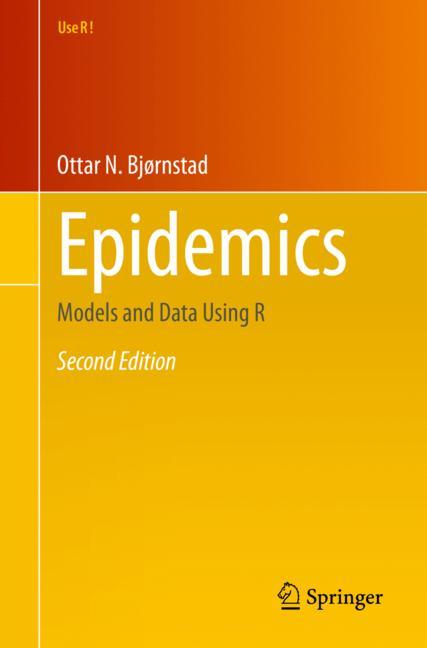
Epidemics
☆☆☆☆☆
(0 opinii)
Najniższa cena (z dostawą)
77,85 EUR
Typowa cena3 082,15 PLN
Najniższa (90 dni)39,19 PLN
Liczba ofert3
Ostatnia aktualizacja1 tydzień temu
Historia ceny (90 dni)
Pełna historia
2026-08-08
2026-08-15
| Zaktualizowano | Cena |
|---|---|
| 2026-08-08 | 52,85 |
| 2026-08-15 | 39,19 |
| Sprzedawca | Cena produktu | Dostawa | Razem | Dostępność | Aktualizacja | |
|---|---|---|---|---|---|---|
| SP SpringerNatureLink Shop INT | 52,85 EUR | 25,00 EUR | 77,85 EUR | Dostępny | 3 dni temu | Zobacz ofertę |
| SP SpringerNatureLink Shop INT | 9 151,00 JPY | 25,00 JPY | 9 176,00 JPY | Dostępny | 3 dni temu | Zobacz ofertę |
| SP Springer Nature Author | 9 151,00 JPY | 0 zł | 9 151,00 JPY | Dostępny | 1 tydzień temu | Zobacz ofertę |
Ceny i dostępność mogą ulec zmianie. Ostatnia aktualizacja: 08.08.2026 23:18.
EAN
9783031120565
Springer Nature
0,0
☆☆☆☆☆
0 opinii
5★
0%
4★
0%
3★
0%
2★
0%
1★
0%
Opinie o produkcie
Brak opinii — bądź pierwszy!
This book is designed to be a practical study in infectious disease dynamics. It offers an easy-to-follow implementation and analysis of mathematical epidemiology. It focuses on recent case studies in order to explore various conceptual, mathematical, and statistical issues. The dynamics of infectious diseases shows a wide diversity of pattern. Some have locally persistent chains-of-transmission, others persist spatially in consumer-resource metapopulations. Some infections are prevalent among the young, some among the old and some are age-invariant. Temporally, some diseases have little variation in prevalence, some have predictable seasonal shifts and others exhibit violent epidemics that may be regular or irregular in their timing. Models and ‘models-with-data’ have proved invaluable for understanding and predicting this diversity, and thence help improve intervention and control. Using mathematical models to understand infectious disease, dynamics has a very richhistory in epidemiology. The field has seen broad expansions of theories as well as a surge in real-life application of mathematics to dynamics and control of infectious disease. The chapters of Epidemics: Models and Data Using R have been organized as follows: chapters 1-10 is a mix and match of models, data and statistics pertaining to local disease dynamics; chapters 11-13 pertains to spatial and spatiotemporal dynamics; chapter 14 highlights similarities between the dynamics of infectious disease and parasitoid-host dynamics; Finally, chapters 15 and 16 overview additional statistical methodology useful in studies of infectious disease dynamics. This book can be used as a guide for working with data, models and ‘models-and-data’ to understand epidemics and infectious disease dynamics in space and time. All the code and data sets are distributed in the epimdr2 R package to facilitate the hands-on philosophy of the text.
Podobne produkty
 50 Years of Philosophy and Medicine
od $107.30
50 Years of Philosophy and Medicine
od $107.30
 Understanding Cybersecurity Law and Digital Privacy
od $122.63
Understanding Cybersecurity Law and Digital Privacy
od $122.63
 Decisions in International Trade and Logistics
od $122.63
Decisions in International Trade and Logistics
od $122.63
 Advances in Economic Measurement
od $122.63
Advances in Economic Measurement
od $122.63
 Nanomaterials
od $137.96
Nanomaterials
od $137.96
 Sustainable Scaffolds-based Strategies in Tissue Engineering and Regenerative Medicine
od $162.87
Sustainable Scaffolds-based Strategies in Tissue Engineering and Regenerative Medicine
od $162.87
 Narratives in Educational Research
od $162.87
Narratives in Educational Research
od $162.87
 Environmental Biology of the Young Chinese Sturgeon
od $210.78
Environmental Biology of the Young Chinese Sturgeon
od $210.78