
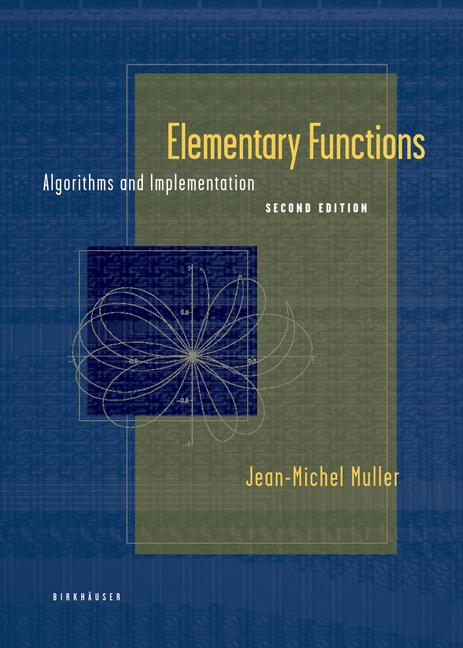
Elementary Functions
☆☆☆☆☆
(0 opinii)
Najniższa cena (z dostawą)
5 733,00 JPY
Typowa cena1 464,00 PLN
Najniższa (90 dni)31,99 PLN
Liczba ofert2
Ostatnia aktualizacja12 godzin temu
| Sprzedawca | Cena produktu | Dostawa | Razem | Dostępność | Aktualizacja | |
|---|---|---|---|---|---|---|
| SP Springer Nature Author | 5 714,00 JPY | 19,00 JPY | 5 733,00 JPY | Dostępny | 12 godzin temu | Zobacz ofertę |
| SP SpringerNatureLink Shop INT | 55,00 EUR | 25,00 EUR | 80,00 EUR | Dostępny | 1 dzień temu | Zobacz ofertę |
Ceny i dostępność mogą ulec zmianie. Ostatnia aktualizacja: 08.08.2026 23:07.
EAN
9780817644086
Springer Nature
0,0
☆☆☆☆☆
0 opinii
5★
0%
4★
0%
3★
0%
2★
0%
1★
0%
Opinie o produkcie
Brak opinii — bądź pierwszy!
"An important topic, which is on the boundary between numerical analysis and computer science …. I found the book well written and containing much interesting material, most of the time disseminated in specialized papers published in specialized journals difficult to find. Moreover, there are very few books on these topics and they are not recent." Numerical Algorithms (review of the first edition) This unique book provides concepts and background necessary to understand and build algorithms for computing the elementary functions. The author presents and structures the algorithms (hardware-oriented as well as software-oriented), and also discusses issues related to accurate floating-point implementation. The purpose is not to give "cookbook recipes" that allow one to implement a given function, but rather to provide the reader with tools necessary to build, or adapt, algorithms to their specific computing environment. The expanded second edition contains a number of revisions and additions, which incorporate numerous new results obtained during the last few years. New algorithms invented since 1997 – such as Matula’s bipartite method, another table-based method due to Ercegovac, Lang, Tisserand, and Muller – as well as a new chapter on multiple-precision arithmetic have been added. In addition, the section on correct rounding of elementary functions has been fully reworked, also in the context of new results. Finally, the introductory presentation of floating-point arithmetic has been expanded, with more emphasis given to the use of the fused multiply-accumulate instruction. The book is an up-to-date presentation of information needed to understand and accurately use mathematical functions and algorithms in computational work and design. Graduates, professionals, and researchers in scientific computing, software engineering, and computer engineering will find the book a useful reference and resource.
Podobne produkty
 Patient Safety Coaching
od $91.97
Patient Safety Coaching
od $91.97
 Ethnography and Diversity
od $69.30
Ethnography and Diversity
od $69.30
 Smart Villages
od $91.97
Smart Villages
od $91.97
 Nuclear Non-Proliferation in International Law - Volume VI
od $91.97
Nuclear Non-Proliferation in International Law - Volume VI
od $91.97
 The Price of Freedom
od $91.97
The Price of Freedom
od $91.97
 Eco-Social Policy in the OECD and the World Bank
od $91.97
Eco-Social Policy in the OECD and the World Bank
od $91.97
 Special Topics in Policing
od $122.58
Special Topics in Policing
od $122.58
 Music from the Heart
od $91.97
Music from the Heart
od $91.97