
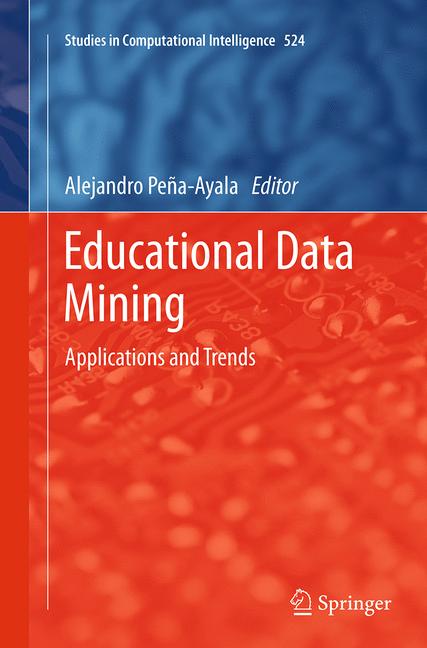
Educational Data Mining
☆☆☆☆☆
(0 opinii)
Najniższa cena (z dostawą)
118,50 GBP
Typowa cena3 129,87 PLN
Najniższa (90 dni)117,69 PLN
Liczba ofert2
Ostatnia aktualizacja1 dzień temu
| Sprzedawca | Cena produktu | Dostawa | Razem | Dostępność | Aktualizacja | |
|---|---|---|---|---|---|---|
| SP SpringerNatureLink Shop INT | 103,50 GBP | 15,00 GBP | 118,50 GBP | Dostępny | 2 dni temu | Zobacz ofertę |
| SP Springer Nature Author | 21 449,00 JPY | 15,00 JPY | 21 464,00 JPY | Dostępny | 1 dzień temu | Zobacz ofertę |
Ceny i dostępność mogą ulec zmianie. Ostatnia aktualizacja: 08.08.2026 23:28.
0,0
☆☆☆☆☆
0 opinii
5★
0%
4★
0%
3★
0%
2★
0%
1★
0%
Opinie o produkcie
Brak opinii — bądź pierwszy!
This book is devoted to the Educational Data Mining arena. It highlights works that show relevant proposals, developments, and achievements that shape trends and inspire future research. After a rigorous revision process sixteen manuscripts were accepted and organized into four parts as follows: · Profile: The first part embraces three chapters oriented to: 1) describe the nature of educational data mining (EDM); 2) describe how to pre-process raw data to facilitate data mining (DM); 3) explain how EDM supports government policies to enhance education. · Student modeling: The second part contains five chapters concerned with: 4) explore the factors having an impact on the student's academic success; 5) detect student's personality and behaviors in an educational game; 6) predict students performance to adjust content and strategies; 7) identify students who will most benefit from tutor support; 8) hypothesize the student answer correctness based on eye metrics and mouse click. · Assessment: The third part has four chapters related to: 9) analyze the coherence of student research proposals; 10) automatically generate tests based on competences; 11) recognize students activities and visualize these activities for being presented to teachers; 12) find the most dependent test items in students response data. · Trends: The fourth part encompasses four chapters about how to: 13) mine text for assessing students productions and supporting teachers; 14) scan student comments by statistical and text mining techniques; 15) sketch a social network analysis (SNA) to discover student behavior profiles and depict models about their collaboration; 16) evaluate the structure of interactions between the students in social networks. This volume will be a source of interest to researchers, practitioners, professors, and postgraduate students aimed at updating their knowledgeand find targets for future work in the field of educational data mining.
Podobne produkty
 Patient Safety Coaching
od $91.97
Patient Safety Coaching
od $91.97
 Ethnography and Diversity
od $69.30
Ethnography and Diversity
od $69.30
 Smart Villages
od $91.97
Smart Villages
od $91.97
 Nuclear Non-Proliferation in International Law - Volume VI
od $91.97
Nuclear Non-Proliferation in International Law - Volume VI
od $91.97
 The Price of Freedom
od $91.97
The Price of Freedom
od $91.97
 Eco-Social Policy in the OECD and the World Bank
od $91.97
Eco-Social Policy in the OECD and the World Bank
od $91.97
 Special Topics in Policing
od $122.58
Special Topics in Policing
od $122.58
 Music from the Heart
od $91.97
Music from the Heart
od $91.97