
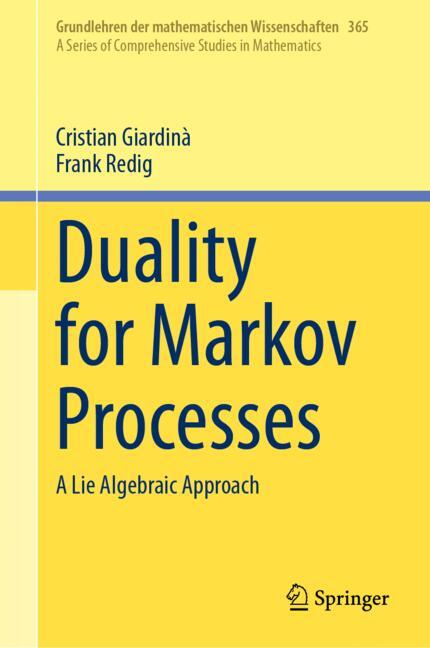
Duality for Markov Processes
☆☆☆☆☆
(0 opinii)
Najniższa cena (z dostawą)
19 466,00 JPY
Typowa cena4 017,65 PLN
Najniższa (90 dni)159,00 PLN
Liczba ofert3
Ostatnia aktualizacja1 tydzień temu
Historia ceny (90 dni)
Pełna historia
2026-08-08
2026-08-15
| Zaktualizowano | Cena |
|---|---|
| 2026-08-08 | 159,00 |
| 2026-08-15 | 160,50 |
| Sprzedawca | Cena produktu | Dostawa | Razem | Dostępność | Aktualizacja | |
|---|---|---|---|---|---|---|
| SP SpringerNatureLink Shop INT | 19 447,00 JPY | 19,00 JPY | 19 466,00 JPY | Dostępny | 4 dni temu | Zobacz ofertę |
| SP Springer Nature Author | 19 447,00 JPY | 19,00 JPY | 19 466,00 JPY | Dostępny | 1 tydzień temu | Zobacz ofertę |
| SP SpringerNatureLink Shop INT | 160,50 EUR | 25,00 EUR | 185,50 EUR | Dostępny | 4 dni temu | Zobacz ofertę |
Ceny i dostępność mogą ulec zmianie. Ostatnia aktualizacja: 08.08.2026 23:32.
EAN
9783032040992
Springer Nature
0,0
☆☆☆☆☆
0 opinii
5★
0%
4★
0%
3★
0%
2★
0%
1★
0%
Opinie o produkcie
Brak opinii — bądź pierwszy!
This monograph studies duality in interacting particle systems, a topic combining probability theory, statistical physics, Lie algebras, and orthogonal polynomials. It offers the first comprehensive account of duality theory in the context of interacting particle systems. Using a Lie algebraic framework, the book demonstrates how dualities arise in families of systems linked to algebraic representations. The exposition centers on three key processes: independent random walks, the inclusion process, and the exclusion process—associated with the Heisenberg, su(1,1), and su(2) algebras, respectively. From these three basic cases, several new processes and their duality relations are derived. Additional models, such as the Brownian energy process, the KMP model and the Kac model, are also discussed, along with topics like the hydrodynamic limit and non-equilibrium behavior. Further, integrable systems associated to the su(1,1) algebra are studied and their non-equilibrium steady states are computed. Intentionally accessible and self-contained, this book is aimed at graduate-level researchers and also serves as a comprehensive introduction to the duality of Markov processes and beyond.
Podobne produkty
 50 Years of Philosophy and Medicine
od $107.30
50 Years of Philosophy and Medicine
od $107.30
 Understanding Cybersecurity Law and Digital Privacy
od $122.63
Understanding Cybersecurity Law and Digital Privacy
od $122.63
 Decisions in International Trade and Logistics
od $122.63
Decisions in International Trade and Logistics
od $122.63
 Advances in Economic Measurement
od $122.63
Advances in Economic Measurement
od $122.63
 Nanomaterials
od $137.96
Nanomaterials
od $137.96
 Sustainable Scaffolds-based Strategies in Tissue Engineering and Regenerative Medicine
od $162.87
Sustainable Scaffolds-based Strategies in Tissue Engineering and Regenerative Medicine
od $162.87
 Narratives in Educational Research
od $162.87
Narratives in Educational Research
od $162.87
 Environmental Biology of the Young Chinese Sturgeon
od $210.78
Environmental Biology of the Young Chinese Sturgeon
od $210.78