
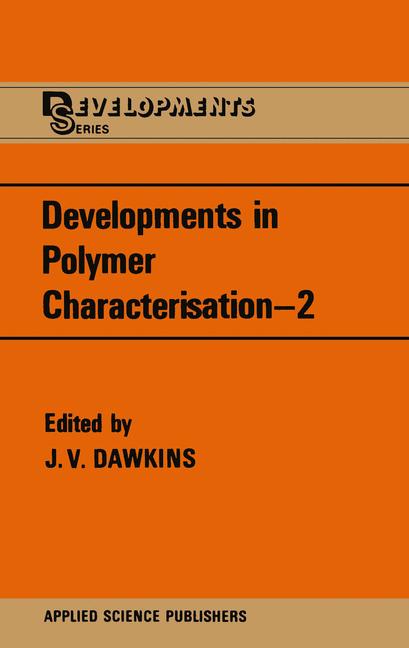
Developments in Polymer Characterisation
☆☆☆☆☆
(0 opinii)
Najniższa cena (z dostawą)
7 178,00 JPY
Typowa cena362,20 PLN
Najniższa (90 dni)49,99 PLN
Liczba ofert2
Ostatnia aktualizacja20 godzin temu
| Sprzedawca | Cena produktu | Dostawa | Razem | Dostępność | Aktualizacja | |
|---|---|---|---|---|---|---|
| SP Springer Nature Author | 7 149,00 JPY | 29,00 JPY | 7 178,00 JPY | Dostępny | 20 godzin temu | Zobacz ofertę |
| SP SpringerNatureLink Shop INT | 59,00 EUR | 19,00 EUR | 78,00 EUR | Dostępny | 1 dzień temu | Zobacz ofertę |
Ceny i dostępność mogą ulec zmianie. Ostatnia aktualizacja: 08.08.2026 23:14.
0,0
☆☆☆☆☆
0 opinii
5★
0%
4★
0%
3★
0%
2★
0%
1★
0%
Opinie o produkcie
Brak opinii — bądź pierwszy!
The policy adopted in Volume 1 of this series of including a relatively small number of topics for detailed review has been continued here. The techniques selected have received considerable attention in recent years. F or this reason and because of the significance of the characterisation data, further coverage of 13C nuclear magnetic resonance spectroscopy and small angle neutron scattering is given in the first two chapters. In Chapter I a large part of the review describes the determination of monomer sequence distributions and configurational sequences in copolymers formed from more than one polymerisable monomer. The review on neutron scattering (Chapter 2) is directed towards the determination of the chain conformation in semi-crystaIIine polymers, which has provided important results for the interpretation of chain folding and morphology in crystaIIisable polymers. Laser Raman spectroscopy has also been used for morphological studies, and this application together with a description of the theoretical and experimental aspects of the technique is given in Chapter 3. X-ray photoelectron spectroscopy because of its extreme sensitivity to surface characteristics has provided information on polymeric solids that could not be obtained by other techniques. The principles and practice of this ESCA technique, including its use for simple elemental analysis, structural elucidation and depth profiling, are described in Chapter 4. The final two chapters are mainly concerned with the chain conformation of polymers in dilute solution. Ultrasonic techniques (Chapter 5) show pmmise for observing the dynamics of conformational changes.
Podobne produkty
 Patient Safety Coaching
od $91.97
Patient Safety Coaching
od $91.97
 Ethnography and Diversity
od $69.30
Ethnography and Diversity
od $69.30
 Smart Villages
od $91.97
Smart Villages
od $91.97
 Nuclear Non-Proliferation in International Law - Volume VI
od $91.97
Nuclear Non-Proliferation in International Law - Volume VI
od $91.97
 The Price of Freedom
od $91.97
The Price of Freedom
od $91.97
 Eco-Social Policy in the OECD and the World Bank
od $91.97
Eco-Social Policy in the OECD and the World Bank
od $91.97
 Special Topics in Policing
od $122.58
Special Topics in Policing
od $122.58
 Music from the Heart
od $91.97
Music from the Heart
od $91.97