
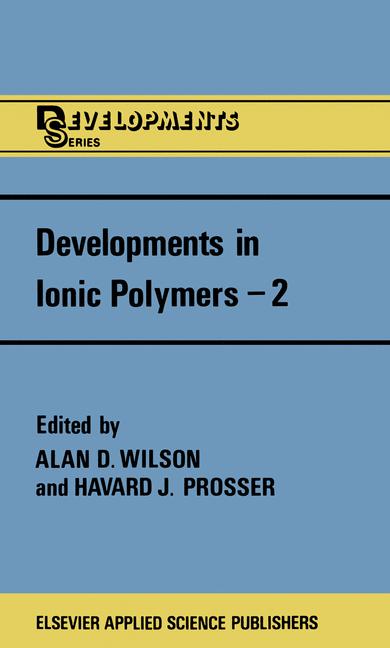
Developments in Ionic Polymers—2
☆☆☆☆☆
(0 opinii)
Najniższa cena (z dostawą)
7 149,00 JPY
Typowa cena362,20 PLN
Najniższa (90 dni)49,99 PLN
Liczba ofert2
Ostatnia aktualizacja13 godzin temu
| Sprzedawca | Cena produktu | Dostawa | Razem | Dostępność | Aktualizacja | |
|---|---|---|---|---|---|---|
| SP Springer Nature Author | 7 149,00 JPY | 0 zł | 7 149,00 JPY | Dostępny | 13 godzin temu | Zobacz ofertę |
| SP SpringerNatureLink Shop INT | 59,00 EUR | 0 zł | 59,00 EUR | Dostępny | 1 dzień temu | Zobacz ofertę |
Ceny i dostępność mogą ulec zmianie. Ostatnia aktualizacja: 08.08.2026 23:14.
0,0
☆☆☆☆☆
0 opinii
5★
0%
4★
0%
3★
0%
2★
0%
1★
0%
Opinie o produkcie
Brak opinii — bądź pierwszy!
Ionic polymers, like elephants, are easier to recognise than to define. Several methods of classification have been attempted but none is wholly satisfactory because of the extreme diversity of ionic polymers, which range from the organic, water-soluble polyelectrolytes, through hydrogels and ionomer carboxylate rubbers, to the almost infusible inorganic silicate minerals. For this reason, a general classification is not only difficult, but has minimal utility. However, there are some characteristics of these materials that should be highlighted. The role of counterions is the significant one. These ions, either singly or as clusters, take part in the formation of ionic bonds which have a varying structural role. Often they act as crosslinks, but in the halato-polymers the ionic bonds form an integral part of the polymer backbone itself. Conversely, in polymers contain ing covalent crosslinks, such as the ion-exchange resins, the coun terions have virtually no structural role to play, since they dwell in cage-like structures without affecting the crosslinking, and are readily exchanged. They are, perhaps, best described as ion-containing polymers rather than structural ionic polymers. Another crucial factor is the role of water in ionic polymers. The presence of ionic bonds means that there is a tendency for these materials to interact with water. Where the ionic polymer contains a high proportion of ionic units, it acts as a hydrogel and may be highly soluble. Such interactions with water decrease sharply as the ionic content is reduced, though even then water can act as a plasticiser.
Podobne produkty
 Patient Safety Coaching
od $91.97
Patient Safety Coaching
od $91.97
 Ethnography and Diversity
od $69.30
Ethnography and Diversity
od $69.30
 Smart Villages
od $91.97
Smart Villages
od $91.97
 Nuclear Non-Proliferation in International Law - Volume VI
od $91.97
Nuclear Non-Proliferation in International Law - Volume VI
od $91.97
 The Price of Freedom
od $91.97
The Price of Freedom
od $91.97
 Eco-Social Policy in the OECD and the World Bank
od $91.97
Eco-Social Policy in the OECD and the World Bank
od $91.97
 Special Topics in Policing
od $122.58
Special Topics in Policing
od $122.58
 Music from the Heart
od $91.97
Music from the Heart
od $91.97