
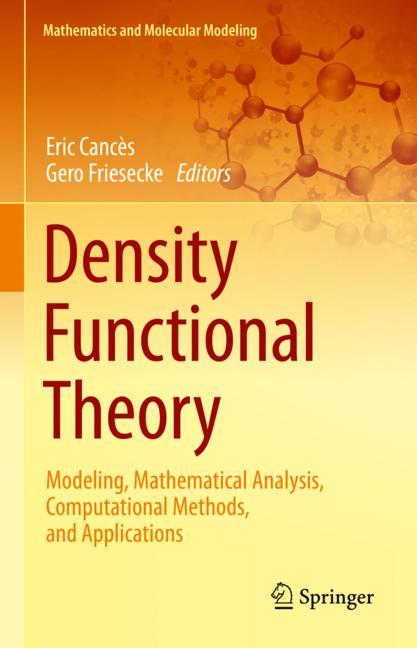
Density Functional Theory
☆☆☆☆☆
(0 opinii)
Najniższa cena (z dostawą)
112,35 EUR
Typowa cena3 334,62 PLN
Najniższa (90 dni)111,30 PLN
Liczba ofert3
Ostatnia aktualizacja1 tydzień temu
Historia ceny (90 dni)
Pełna historia
2026-08-08
2026-08-15
| Zaktualizowano | Cena |
|---|---|
| 2026-08-08 | 111,30 |
| 2026-08-15 | 112,35 |
| Sprzedawca | Cena produktu | Dostawa | Razem | Dostępność | Aktualizacja | |
|---|---|---|---|---|---|---|
| SP SpringerNatureLink Shop INT | 112,35 EUR | 0 zł | 112,35 EUR | Dostępny | 4 dni temu | Zobacz ofertę |
| SP SpringerNatureLink Shop INT | 19 447,00 JPY | 0 zł | 19 447,00 JPY | Dostępny | 4 dni temu | Zobacz ofertę |
| SP Springer Nature Author | 19 447,00 JPY | 25,00 JPY | 19 472,00 JPY | Dostępny | 1 tydzień temu | Zobacz ofertę |
Ceny i dostępność mogą ulec zmianie. Ostatnia aktualizacja: 08.08.2026 23:32.
EAN
9783031223402
Springer Nature
0,0
☆☆☆☆☆
0 opinii
5★
0%
4★
0%
3★
0%
2★
0%
1★
0%
Opinie o produkcie
Brak opinii — bądź pierwszy!
Density functional theory (DFT) provides the most widely used models for simulating molecules and materials based on the fundamental laws of quantum mechanics. It plays a central role in a huge spectrum of applications in chemistry, physics, and materials science. Quantum mechanics describes a system of N interacting particles in the physical 3-dimensional space by a partial differential equation in 3N spatial variables. The standard numerical methods thus incur an exponential increase of computational effort with N, a phenomenon known as the curse of dimensionality; in practice these methods already fail beyond N=2. DFT overcomes this problem by 1) reformulating the N-body problem involving functions of 3N variables in terms of the density, a function of 3 variables, 2) approximating it by a pioneering hybrid approach which keeps important ab initio contributions and re-models the remainder in a data-driven way. This book intends to be an accessible, yet state-of-art text on DFT for graduate students and researchers in applied and computational mathematics, physics, chemistry, and materials science. It introduces and reviews the main models of DFT, covering their derivation and mathematical properties, numerical treatment, and applications.
Podobne produkty
 50 Years of Philosophy and Medicine
od $107.30
50 Years of Philosophy and Medicine
od $107.30
 Understanding Cybersecurity Law and Digital Privacy
od $122.63
Understanding Cybersecurity Law and Digital Privacy
od $122.63
 Decisions in International Trade and Logistics
od $122.63
Decisions in International Trade and Logistics
od $122.63
 Advances in Economic Measurement
od $122.63
Advances in Economic Measurement
od $122.63
 Nanomaterials
od $137.96
Nanomaterials
od $137.96
 Sustainable Scaffolds-based Strategies in Tissue Engineering and Regenerative Medicine
od $162.87
Sustainable Scaffolds-based Strategies in Tissue Engineering and Regenerative Medicine
od $162.87
 Narratives in Educational Research
od $162.87
Narratives in Educational Research
od $162.87
 Environmental Biology of the Young Chinese Sturgeon
od $210.78
Environmental Biology of the Young Chinese Sturgeon
od $210.78