
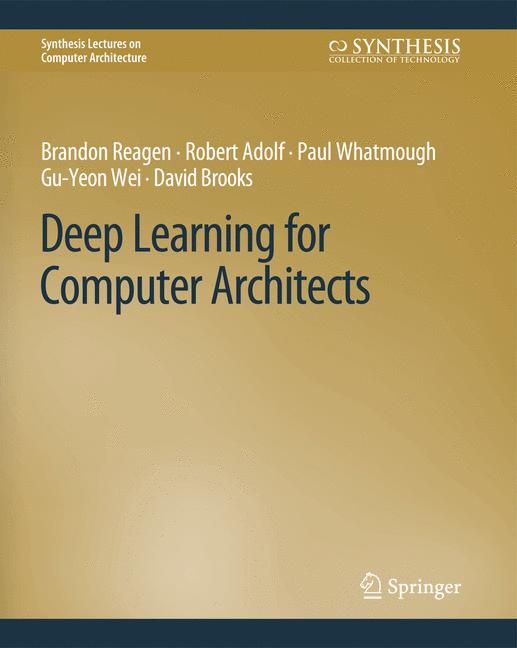
Deep Learning for Computer Architects
☆☆☆☆☆
(0 opinii)
Najniższa cena (z dostawą)
7 864,00 JPY
Typowa cena1 036,16 PLN
Najniższa (90 dni)57,19 PLN
Liczba ofert3
Ostatnia aktualizacja1 tydzień temu
Historia ceny (90 dni)
Pełna historia
2026-08-08
2026-08-15
| Zaktualizowano | Cena |
|---|---|
| 2026-08-08 | 58,01 |
| 2026-08-15 | 57,19 |
| Sprzedawca | Cena produktu | Dostawa | Razem | Dostępność | Aktualizacja | |
|---|---|---|---|---|---|---|
| SP SpringerNatureLink Shop INT | 7 864,00 JPY | 0 zł | 7 864,00 JPY | Dostępny | 3 dni temu | Zobacz ofertę |
| SP Springer Nature Author | 7 864,00 JPY | 0 zł | 7 864,00 JPY | Dostępny | 1 tydzień temu | Zobacz ofertę |
| SP SpringerNatureLink Shop INT | 65,00 EUR | 19,00 EUR | 84,00 EUR | Dostępny | 3 dni temu | Zobacz ofertę |
Ceny i dostępność mogą ulec zmianie. Ostatnia aktualizacja: 08.08.2026 23:16.
EAN
9783031006289
Springer Nature
0,0
☆☆☆☆☆
0 opinii
5★
0%
4★
0%
3★
0%
2★
0%
1★
0%
Opinie o produkcie
Brak opinii — bądź pierwszy!
Machine learning, and specifically deep learning, has been hugely disruptive in many fields of computer science. The success of deep learning techniques in solving notoriously difficult classification and regression problems has resulted in their rapid adoption in solving real-world problems. The emergence of deep learning is widely attributed to a virtuous cycle whereby fundamental advancements in training deeper models were enabled by the availability of massive datasets and high-performance computer hardware. This text serves as a primer for computer architects in a new and rapidly evolving field. We review how machine learning has evolved since its inception in the 1960s and track the key developments leading up to the emergence of the powerful deep learning techniques that emerged in the last decade. Next we review representative workloads, including the most commonly used datasets and seminal networks across a variety of domains. In addition to discussing the workloadsthemselves, we also detail the most popular deep learning tools and show how aspiring practitioners can use the tools with the workloads to characterize and optimize DNNs. The remainder of the book is dedicated to the design and optimization of hardware and architectures for machine learning. As high-performance hardware was so instrumental in the success of machine learning becoming a practical solution, this chapter recounts a variety of optimizations proposed recently to further improve future designs. Finally, we present a review of recent research published in the area as well as a taxonomy to help readers understand how various contributions fall in context.
Podobne produkty
 50 Years of Philosophy and Medicine
od $107.30
50 Years of Philosophy and Medicine
od $107.30
 Understanding Cybersecurity Law and Digital Privacy
od $122.63
Understanding Cybersecurity Law and Digital Privacy
od $122.63
 Decisions in International Trade and Logistics
od $122.63
Decisions in International Trade and Logistics
od $122.63
 Advances in Economic Measurement
od $122.63
Advances in Economic Measurement
od $122.63
 Nanomaterials
od $137.96
Nanomaterials
od $137.96
 Sustainable Scaffolds-based Strategies in Tissue Engineering and Regenerative Medicine
od $162.87
Sustainable Scaffolds-based Strategies in Tissue Engineering and Regenerative Medicine
od $162.87
 Narratives in Educational Research
od $162.87
Narratives in Educational Research
od $162.87
 Environmental Biology of the Young Chinese Sturgeon
od $210.78
Environmental Biology of the Young Chinese Sturgeon
od $210.78