
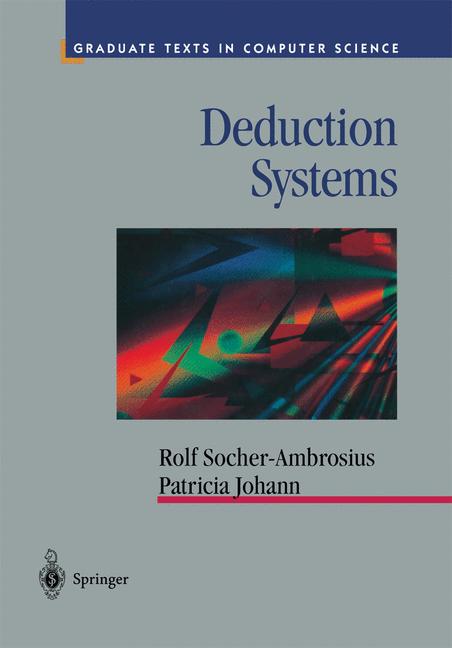
Deduction Systems
☆☆☆☆☆
(0 opinii)
Najniższa cena (z dostawą)
7 149,00 JPY
Typowa cena362,20 PLN
Najniższa (90 dni)49,99 PLN
Liczba ofert2
Ostatnia aktualizacja3 godziny temu
| Sprzedawca | Cena produktu | Dostawa | Razem | Dostępność | Aktualizacja | |
|---|---|---|---|---|---|---|
| SP Springer Nature Author | 7 149,00 JPY | 0 zł | 7 149,00 JPY | Dostępny | 3 godziny temu | Zobacz ofertę |
| SP SpringerNatureLink Shop INT | 59,00 EUR | 15,00 EUR | 74,00 EUR | Dostępny | 15 godzin temu | Zobacz ofertę |
Ceny i dostępność mogą ulec zmianie. Ostatnia aktualizacja: 08.08.2026 23:12.
0,0
☆☆☆☆☆
0 opinii
5★
0%
4★
0%
3★
0%
2★
0%
1★
0%
Opinie o produkcie
Brak opinii — bądź pierwszy!
The idea of mechanizing deductive reasoning can be traced all the way back to Leibniz, who proposed the development of a rational calculus for this purpose. But it was not until the appearance of Frege's 1879 Begriffsschrift-"not only the direct ancestor of contemporary systems of mathematical logic, but also the ancestor of all formal languages, including computer programming languages" ([Dav83])-that the fundamental concepts of modern mathematical logic were developed. Whitehead and Russell showed in their Principia Mathematica that the entirety of classical mathematics can be developed within the framework of a formal calculus, and in 1930, Skolem, Herbrand, and Godel demonstrated that the first-order predicate calculus (which is such a calculus) is complete, i. e. , that every valid formula in the language of the predicate calculus is derivable from its axioms. Skolem, Herbrand, and GOdel further proved that in order to mechanize reasoning within the predicate calculus, it suffices to Herbrand consider only interpretations of formulae over their associated universes. We will see that the upshot of this discovery is that the validity of a formula in the predicate calculus can be deduced from the structure of its constituents, so that a machine might perform the logical inferences required to determine its validity. With the advent of computers in the 1950s there developed an interest in automatic theorem proving.
Podobne produkty
 Patient Safety Coaching
od $91.97
Patient Safety Coaching
od $91.97
 Ethnography and Diversity
od $69.30
Ethnography and Diversity
od $69.30
 Smart Villages
od $91.97
Smart Villages
od $91.97
 Nuclear Non-Proliferation in International Law - Volume VI
od $91.97
Nuclear Non-Proliferation in International Law - Volume VI
od $91.97
 The Price of Freedom
od $91.97
The Price of Freedom
od $91.97
 Eco-Social Policy in the OECD and the World Bank
od $91.97
Eco-Social Policy in the OECD and the World Bank
od $91.97
 Special Topics in Policing
od $122.58
Special Topics in Policing
od $122.58
 Music from the Heart
od $91.97
Music from the Heart
od $91.97