
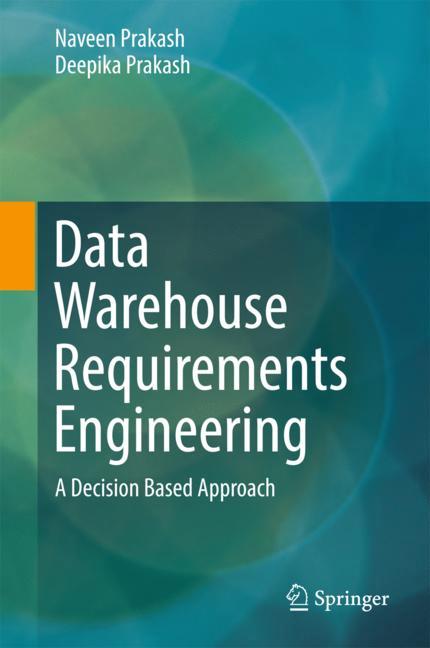
Data Warehouse Requirements Engineering
☆☆☆☆☆
(0 opinii)
Najniższa cena (z dostawą)
6 882,00 JPY
Typowa cena2 323,26 PLN
Najniższa (90 dni)50,28 PLN
Liczba ofert3
Ostatnia aktualizacja1 tydzień temu
| Sprzedawca | Cena produktu | Dostawa | Razem | Dostępność | Aktualizacja | |
|---|---|---|---|---|---|---|
| SP SpringerNatureLink Shop INT | 6 863,00 JPY | 19,00 JPY | 6 882,00 JPY | Dostępny | 6 dni temu | Zobacz ofertę |
| SP Springer Nature Author | 6 863,00 JPY | 15,00 JPY | 6 878,00 JPY | Dostępny | 1 tydzień temu | Zobacz ofertę |
| SP SpringerNatureLink Shop INT | 56,50 EUR | 0 zł | 56,50 EUR | Dostępny | 6 dni temu | Zobacz ofertę |
Ceny i dostępność mogą ulec zmianie. Ostatnia aktualizacja: 08.08.2026 23:11.
EAN
9789811070198
Springer Nature
0,0
☆☆☆☆☆
0 opinii
5★
0%
4★
0%
3★
0%
2★
0%
1★
0%
Opinie o produkcie
Brak opinii — bądź pierwszy!
As the first to focus on the issue of Data Warehouse Requirements Engineering, this book introduces a model-driven requirements process used to identify requirements granules and incrementally develop data warehouse fragments. In addition, it presents an approach to the pair-wise integration of requirements granules for consolidating multiple data warehouse fragments. The process is systematic and does away with the fuzziness associated with existing techniques. Thus, consolidation is treated as a requirements engineering issue. The notion of a decision occupies a central position in the decision-based approach. On one hand, information relevant to a decision must be elicited from stakeholders; modeled; and transformed into multi-dimensional form. On the other, decisions themselves are to be obtained from decision applications. For the former, the authors introduce a suite of information elicitation techniques specific to data warehousing. This information is subsequently converted into multi-dimensional form. For the latter, not only are decisions obtained from decision applications for managing operational businesses, but also from applications for formulating business policies and for defining rules for enforcing policies, respectively. In this context, the book presents a broad range of models, tools and techniques. For readers from academia, the book identifies the scientific/technological problems it addresses and provides cogent arguments for the proposed solutions; for readers from industry, it presents an approach for ensuring that the product meets its requirements while ensuring low lead times in delivery.
Podobne produkty
 50 Years of Philosophy and Medicine
od $107.30
50 Years of Philosophy and Medicine
od $107.30
 Understanding Cybersecurity Law and Digital Privacy
od $122.63
Understanding Cybersecurity Law and Digital Privacy
od $122.63
 Decisions in International Trade and Logistics
od $122.63
Decisions in International Trade and Logistics
od $122.63
 Advances in Economic Measurement
od $122.63
Advances in Economic Measurement
od $122.63
 Nanomaterials
od $137.96
Nanomaterials
od $137.96
 Sustainable Scaffolds-based Strategies in Tissue Engineering and Regenerative Medicine
od $162.87
Sustainable Scaffolds-based Strategies in Tissue Engineering and Regenerative Medicine
od $162.87
 Narratives in Educational Research
od $162.87
Narratives in Educational Research
od $162.87
 Environmental Biology of the Young Chinese Sturgeon
od $210.78
Environmental Biology of the Young Chinese Sturgeon
od $210.78