
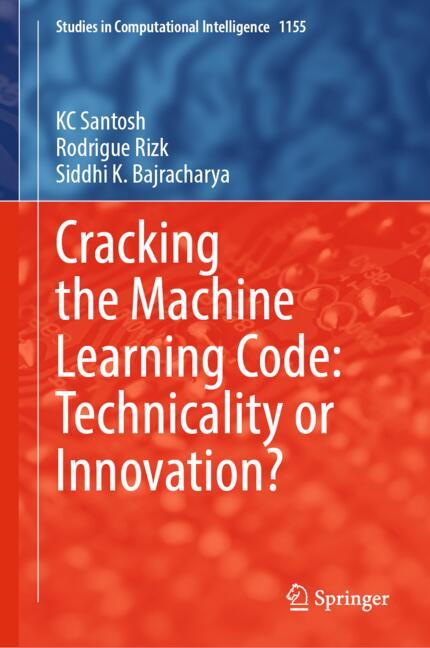
Cracking the Machine Learning Code: Technicality or Innovation?
☆☆☆☆☆
(0 opinii)
Najniższa cena (z dostawą)
18 322,00 JPY
Typowa cena4 679,13 PLN
Najniższa (90 dni)111,50 PLN
Liczba ofert3
Ostatnia aktualizacja1 tydzień temu
| Sprzedawca | Cena produktu | Dostawa | Razem | Dostępność | Aktualizacja | |
|---|---|---|---|---|---|---|
| SP SpringerNatureLink Shop INT | 18 303,00 JPY | 19,00 JPY | 18 322,00 JPY | Dostępny | 3 dni temu | Zobacz ofertę |
| SP Springer Nature Author | 18 303,00 JPY | 0 zł | 18 303,00 JPY | Dostępny | 1 tydzień temu | Zobacz ofertę |
| SP SpringerNatureLink Shop INT | 111,50 GBP | 0 zł | 111,50 GBP | Dostępny | 3 dni temu | Zobacz ofertę |
Ceny i dostępność mogą ulec zmianie. Ostatnia aktualizacja: 08.08.2026 23:29.
EAN
9789819727209
Springer Nature
0,0
☆☆☆☆☆
0 opinii
5★
0%
4★
0%
3★
0%
2★
0%
1★
0%
Opinie o produkcie
Brak opinii — bądź pierwszy!
Employing off-the-shelf machine learning models is not an innovation. The journey through technicalities and innovation in the machine learning field is ongoing, and we hope this book serves as a compass, guiding the readers through the evolving landscape of artificial intelligence. It typically includes model selection, parameter tuning and optimization, use of pre-trained models and transfer learning, right use of limited data, model interpretability and explainability, feature engineering and autoML robustness and security, and computational cost – efficiency and scalability. Innovation in building machine learning models involves a continuous cycle of exploration, experimentation, and improvement, with a focus on pushing the boundaries of what is achievable while considering ethical implications and real-world applicability. The book is aimed at providing a clear guidance that one should not be limited to building pre-trained models to solve problems using the off-the-self basic building blocks. With primarily three different data types: numerical, textual, and image data, we offer practical applications such as predictive analysis for finance and housing, text mining from media/news, and abnormality screening for medical imaging informatics. To facilitate comprehension and reproducibility, authors offer GitHub source code encompassing fundamental components and advanced machine learning tools.
Podobne produkty
 50 Years of Philosophy and Medicine
od $107.30
50 Years of Philosophy and Medicine
od $107.30
 Understanding Cybersecurity Law and Digital Privacy
od $122.63
Understanding Cybersecurity Law and Digital Privacy
od $122.63
 Decisions in International Trade and Logistics
od $122.63
Decisions in International Trade and Logistics
od $122.63
 Advances in Economic Measurement
od $122.63
Advances in Economic Measurement
od $122.63
 Nanomaterials
od $137.96
Nanomaterials
od $137.96
 Sustainable Scaffolds-based Strategies in Tissue Engineering and Regenerative Medicine
od $162.87
Sustainable Scaffolds-based Strategies in Tissue Engineering and Regenerative Medicine
od $162.87
 Narratives in Educational Research
od $162.87
Narratives in Educational Research
od $162.87
 Environmental Biology of the Young Chinese Sturgeon
od $210.78
Environmental Biology of the Young Chinese Sturgeon
od $210.78