
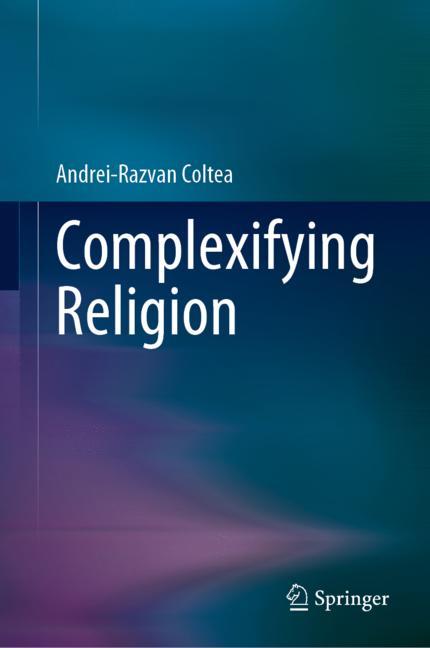
Complexifying Religion
☆☆☆☆☆
(0 opinii)
Najniższa cena (z dostawą)
14 886,00 JPY
Typowa cena3 804,92 PLN
Najniższa (90 dni)111,27 PLN
Liczba ofert3
Ostatnia aktualizacja3 dni temu
Historia ceny (90 dni)
Pełna historia
2026-08-08
2026-08-15
| Zaktualizowano | Cena |
|---|---|
| 2026-08-08 | 111,27 |
| 2026-08-15 | 123,00 |
| Sprzedawca | Cena produktu | Dostawa | Razem | Dostępność | Aktualizacja | |
|---|---|---|---|---|---|---|
| SP SpringerNatureLink Shop INT | 14 871,00 JPY | 15,00 JPY | 14 886,00 JPY | Dostępny | 3 dni temu | Zobacz ofertę |
| SP SpringerNatureLink Shop INT | 123,00 EUR | 0 zł | 123,00 EUR | Dostępny | 3 dni temu | Zobacz ofertę |
| SP Springer Nature Author | 123,00 EUR | 0 zł | 123,00 EUR | Dostępny | 1 tydzień temu | Zobacz ofertę |
Ceny i dostępność mogą ulec zmianie. Ostatnia aktualizacja: 15.08.2026 08:04.
EAN
9789819947010
Springer Nature
0,0
☆☆☆☆☆
0 opinii
5★
0%
4★
0%
3★
0%
2★
0%
1★
0%
Opinie o produkcie
Brak opinii — bądź pierwszy!
This book provides an original and challenging perspective of religions as abstract complex adaptive systems, using an interdisciplinary approach to try to understand what religions are and how they function, two fundamental issues which, despite an intense struggle from several fields, have not yet been resolved. What is the source of religious belief? How do religions work and what are they made of? Why is religion so important for us that it has survived centuries of scientific progress and secularization? Why are people religious even outside religion? The book addresses these questions using an interdisciplinary approach that seeks to untangle the Gordian knot of defining religion. In short, they can be considered entropy-reducing technologies. What differentiates them from other meaning-producing systems is their configuration which employs specific building blocks as tools for mitigating entropy, which are also subsystems and combine in various ways to build a unique configuration: rituals, myths, taboos, supernatural agents, authority, identity, superstitions, moral obligations, afterlife beliefs and the sacred. As a reaction to perturbances or pressure, systems can collapse. Inspired by Nicholas Nassim Taleb, it is, in this book, referred to as fragility—the negative reaction of systems to random events, and four parameters can be used to evaluate it in religious systems: monotonicity (the inability to learn from past mistakes), coupling (linking with other systems: such as political or economic), centralization and stress starvation. Several case studies are provided in order to test the theoretical claims made in this book, based on the author's field research in Romania, Japan, North Korea and Mongolia, and offering details that could be of interest to casual readers, students and researchers of religion.
Podobne produkty
 50 Years of Philosophy and Medicine
od $107.30
50 Years of Philosophy and Medicine
od $107.30
 Understanding Cybersecurity Law and Digital Privacy
od $122.63
Understanding Cybersecurity Law and Digital Privacy
od $122.63
 Decisions in International Trade and Logistics
od $122.63
Decisions in International Trade and Logistics
od $122.63
 Advances in Economic Measurement
od $122.63
Advances in Economic Measurement
od $122.63
 Nanomaterials
od $137.96
Nanomaterials
od $137.96
 Sustainable Scaffolds-based Strategies in Tissue Engineering and Regenerative Medicine
od $162.87
Sustainable Scaffolds-based Strategies in Tissue Engineering and Regenerative Medicine
od $162.87
 Narratives in Educational Research
od $162.87
Narratives in Educational Research
od $162.87
 Environmental Biology of the Young Chinese Sturgeon
od $210.78
Environmental Biology of the Young Chinese Sturgeon
od $210.78