
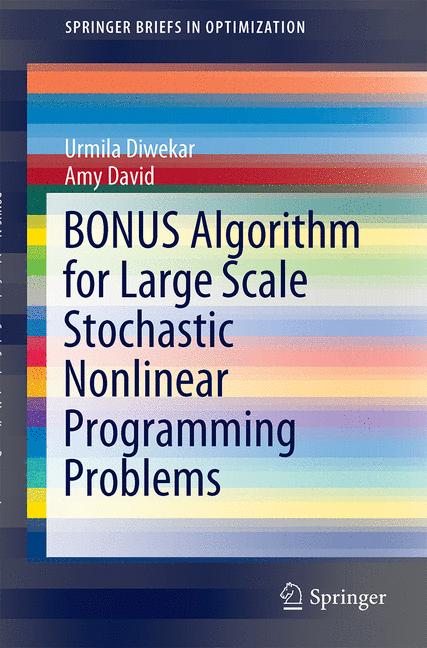
BONUS Algorithm for Large Scale Stochastic Nonlinear Programming Problems
☆☆☆☆☆
(0 opinii)
Najniższa cena (z dostawą)
7 168,00 JPY
Typowa cena314,07 PLN
Najniższa (90 dni)39,99 PLN
Liczba ofert2
Ostatnia aktualizacja16 godzin temu
| Sprzedawca | Cena produktu | Dostawa | Razem | Dostępność | Aktualizacja | |
|---|---|---|---|---|---|---|
| SP Springer Nature Author | 7 149,00 JPY | 19,00 JPY | 7 168,00 JPY | Dostępny | 16 godzin temu | Zobacz ofertę |
| SP SpringerNatureLink Shop INT | 59,00 EUR | 19,00 EUR | 78,00 EUR | Dostępny | 1 dzień temu | Zobacz ofertę |
Ceny i dostępność mogą ulec zmianie. Ostatnia aktualizacja: 08.08.2026 23:08.
0,0
☆☆☆☆☆
0 opinii
5★
0%
4★
0%
3★
0%
2★
0%
1★
0%
Opinie o produkcie
Brak opinii — bądź pierwszy!
This book presents the details of the BONUS algorithm and its real world applications in areas like sensor placement in large scale drinking water networks, sensor placement in advanced power systems, water management in power systems, and capacity expansion of energy systems. A generalized method for stochastic nonlinear programming based on a sampling based approach for uncertainty analysis and statistical reweighting to obtain probability information is demonstrated in this book. Stochastic optimization problems are difficult to solve since they involve dealing with optimization and uncertainty loops. There are two fundamental approaches used to solve such problems. The first being the decomposition techniques and the second method identifies problem specific structures and transforms the problem into a deterministic nonlinear programming problem. These techniques have significant limitations on either the objective function type or the underlying distributions for the uncertain variables. Moreover, these methods assume that there are a small number of scenarios to be evaluated for calculation of the probabilistic objective function and constraints. This book begins to tackle these issues by describing a generalized method for stochastic nonlinear programming problems. This title is best suited for practitioners, researchers and students in engineering, operations research, and management science who desire a complete understanding of the BONUS algorithm and its applications to the real world.
Podobne produkty
 Patient Safety Coaching
od $91.97
Patient Safety Coaching
od $91.97
 Ethnography and Diversity
od $69.30
Ethnography and Diversity
od $69.30
 Smart Villages
od $91.97
Smart Villages
od $91.97
 Nuclear Non-Proliferation in International Law - Volume VI
od $91.97
Nuclear Non-Proliferation in International Law - Volume VI
od $91.97
 The Price of Freedom
od $91.97
The Price of Freedom
od $91.97
 Eco-Social Policy in the OECD and the World Bank
od $91.97
Eco-Social Policy in the OECD and the World Bank
od $91.97
 Special Topics in Policing
od $122.58
Special Topics in Policing
od $122.58
 Music from the Heart
od $91.97
Music from the Heart
od $91.97