
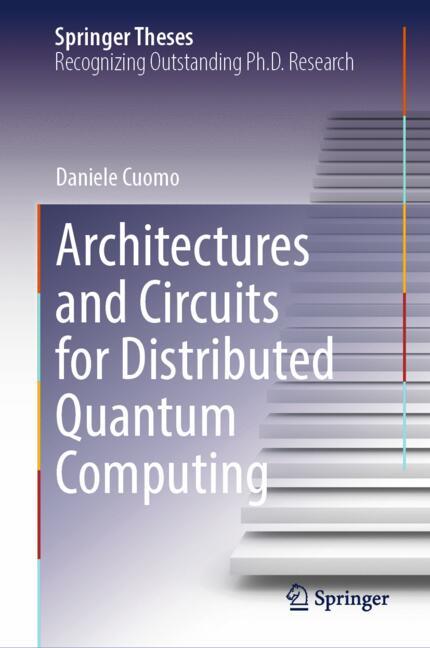
Architectures and Circuits for Distributed Quantum Computing
☆☆☆☆☆
(0 opinii)
Najniższa cena (z dostawą)
24 328,00 JPY
Typowa cena3 418,28 PLN
Najniższa (90 dni)44,85 PLN
Liczba ofert4
Ostatnia aktualizacja1 tydzień temu
| Sprzedawca | Cena produktu | Dostawa | Razem | Dostępność | Aktualizacja | |
|---|---|---|---|---|---|---|
| SP SpringerNatureLink Shop INT | 24 309,00 JPY | 19,00 JPY | 24 328,00 JPY | Dostępny | 4 dni temu | Zobacz ofertę |
| SP Springer Nature Author | 24 309,00 JPY | 29,00 JPY | 24 338,00 JPY | Dostępny | 1 tydzień temu | Zobacz ofertę |
| SP SpringerNatureLink Shop INT | 201,00 EUR | 0 zł | 201,00 EUR | Dostępny | 4 dni temu | Zobacz ofertę |
| VI VitalSource | 1 075,87 ZAR | 25,00 ZAR | 1 100,87 ZAR | Dostępny | 1 tydzień temu | Zobacz ofertę |
Ceny i dostępność mogą ulec zmianie. Ostatnia aktualizacja: 08.08.2026 06:35.
EAN
9783031738074
Springer Nature
0,0
☆☆☆☆☆
0 opinii
5★
0%
4★
0%
3★
0%
2★
0%
1★
0%
Opinie o produkcie
Brak opinii — bądź pierwszy!
This thesis treats networks providing quantum computation based on distributed paradigms. Compared to architectures relying on one processor, a network promises to be more scalable and less fault-prone. Developing a distributed system able to provide practical quantum computation comes with numerous challenges, each of which need to be faced with careful analysis in order to create a seamless integration of multiple engineered components. In accordance with hardware technologies, currently under development worldwide, telegates represent the fundamental inter-processor operations. Each telegate consists of several tasks: i) entanglement generation and distribution, ii) local operations, and iii) classical communications. Entanglement generation and distribution is an expensive resource, as it is time-consuming. The primary contribution of this thesis lies in the extensive analysis of some complex scenarios of general interest. We propose numerical models that help to identifythe interdependence between computation and communication. With the support of some of the best tools for reasoning -- i.e. network optimization, circuit manipulation, group theory and ZX-calculus -- we lay out new perspectives on the way a distributed quantum computing system should be developed.
Podobne produkty
 50 Years of Philosophy and Medicine
od $107.30
50 Years of Philosophy and Medicine
od $107.30
 Understanding Cybersecurity Law and Digital Privacy
od $122.63
Understanding Cybersecurity Law and Digital Privacy
od $122.63
 Decisions in International Trade and Logistics
od $122.63
Decisions in International Trade and Logistics
od $122.63
 Advances in Economic Measurement
od $122.63
Advances in Economic Measurement
od $122.63
 Nanomaterials
od $137.96
Nanomaterials
od $137.96
 Sustainable Scaffolds-based Strategies in Tissue Engineering and Regenerative Medicine
od $162.87
Sustainable Scaffolds-based Strategies in Tissue Engineering and Regenerative Medicine
od $162.87
 Narratives in Educational Research
od $162.87
Narratives in Educational Research
od $162.87
 Environmental Biology of the Young Chinese Sturgeon
od $210.78
Environmental Biology of the Young Chinese Sturgeon
od $210.78