
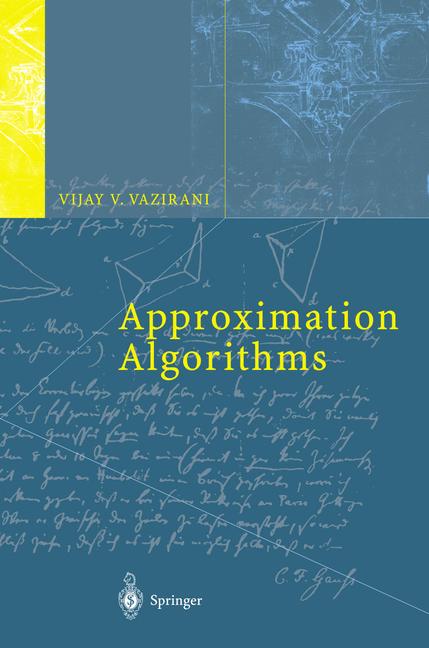
Approximation Algorithms
☆☆☆☆☆
(0 opinii)
Najniższa cena (z dostawą)
98,99 EUR
Typowa cena71,93 PLN
Najniższa (90 dni)17,10 PLN
Liczba ofert3
Ostatnia aktualizacja20 godzin temu
Historia ceny (90 dni)
Pełna historia
2026-08-07
2026-08-08
| Zaktualizowano | Cena |
|---|---|
| 2026-08-07 | 17,10 |
| 2026-08-08 | 33,69 |
| Sprzedawca | Cena produktu | Dostawa | Razem | Dostępność | Aktualizacja | |
|---|---|---|---|---|---|---|
| SP Springer Nature Author | 98,99 EUR | 0 zł | 98,99 EUR | Dostępny | 5 godzin temu | Zobacz ofertę |
| SP SpringerNatureLink Shop INT | 106,50 EUR | 15,00 EUR | 121,50 EUR | Dostępny | 12 godzin temu | Zobacz ofertę |
| VI VitalSource | 455,40 ZAR | 0 zł | 455,40 ZAR | Dostępny | 20 godzin temu | Zobacz ofertę |
Ceny i dostępność mogą ulec zmianie. Ostatnia aktualizacja: 08.08.2026 06:06.
EAN
9783540653677
Springer Nature
0,0
☆☆☆☆☆
0 opinii
5★
0%
4★
0%
3★
0%
2★
0%
1★
0%
Opinie o produkcie
Brak opinii — bądź pierwszy!
Most natural optimization problems, including those arising in important application areas, are NP-hard. Therefore, under the widely believed conjecture that P≠NP, their exact solution is prohibitively time consuming. Charting the landscape of approximability of these problems, via polynomial-time algorithms, therefore becomes a compelling subject of scientific inquiry in computer science and mathematics. This book presents the theory of approximation algorithms. This book is divided into three parts. Part I covers combinatorial algorithms for a number of important problems, using a wide variety of algorithm design techniques. Part II presents linear programming based algorithms. These are categorized under two fundamental techniques: rounding and the primal-dual schema. Part III covers four important topics: the first is the problem of finding a shortest vector in a lattice; the second is the approximability of counting, as opposed to optimization, problems; the third topic is centered around recent breakthrough results, establishing hardness of approximation for many key problems, and giving new legitimacy to approximation algorithms as a deep theory; and the fourth topic consists of the numerous open problems of this young field. This book is suitable for use in advanced undergraduate and graduate-level courses on approximation algorithms. An undergraduate course in algorithms and the theory of NP-completeness should suffice as a prerequisite for most of the chapters. This book can also be used as supplementary text in basic undergraduate and graduate algorithms courses.
Podobne produkty
 Gamma Knife Neurosurgery in the Management of Intracranial Disorders
od $210.78
Gamma Knife Neurosurgery in the Management of Intracranial Disorders
od $210.78
 SDGs in Construction Economics and Organization
od $210.78
SDGs in Construction Economics and Organization
od $210.78
 Emerging Therapies in Neurorehabilitation III
od $210.78
Emerging Therapies in Neurorehabilitation III
od $210.78
 Ground Improvement Techniques
od $220.36
Ground Improvement Techniques
od $220.36
 Anomaly Detection in Video Surveillance
od $220.36
Anomaly Detection in Video Surveillance
od $220.36
 Mechanism and Machine Science
od $287.42
Mechanism and Machine Science
od $287.42
 Protein-Protein Interactions as New Drug Targets
od $287.42
Protein-Protein Interactions as New Drug Targets
od $287.42
 Proceedings of the 7th International Conference of Transportation Research Group of India (CTRG 2023
od $287.42
Proceedings of the 7th International Conference of Transportation Research Group of India (CTRG 2023
od $287.42