
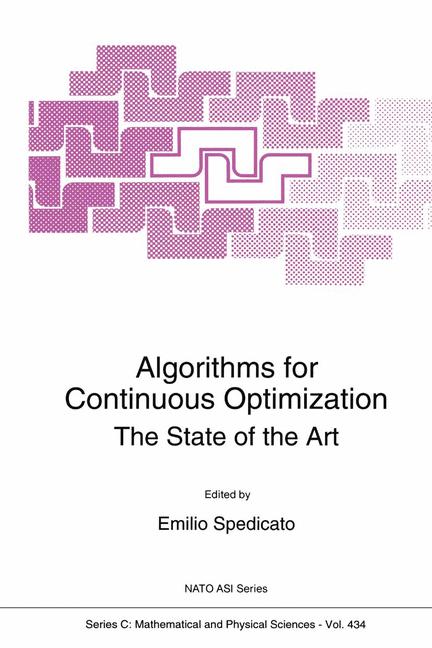
Algorithms for Continuous Optimization
☆☆☆☆☆
(0 opinii)
Najniższa cena (z dostawą)
7 149,00 JPY
Typowa cena362,20 PLN
Najniższa (90 dni)49,99 PLN
Liczba ofert2
Ostatnia aktualizacja14 godzin temu
| Sprzedawca | Cena produktu | Dostawa | Razem | Dostępność | Aktualizacja | |
|---|---|---|---|---|---|---|
| SP Springer Nature Author | 7 149,00 JPY | 0 zł | 7 149,00 JPY | Dostępny | 14 godzin temu | Zobacz ofertę |
| SP SpringerNatureLink Shop INT | 59,00 EUR | 29,00 EUR | 88,00 EUR | Dostępny | 1 dzień temu | Zobacz ofertę |
Ceny i dostępność mogą ulec zmianie. Ostatnia aktualizacja: 08.08.2026 23:14.
0,0
☆☆☆☆☆
0 opinii
5★
0%
4★
0%
3★
0%
2★
0%
1★
0%
Opinie o produkcie
Brak opinii — bądź pierwszy!
The NATO Advanced Study Institute on "Algorithms for continuous optimiza tion: the state of the art" was held September 5-18, 1993, at II Ciocco, Barga, Italy. It was attended by 75 students (among them many well known specialists in optimiza tion) from the following countries: Belgium, Brasil, Canada, China, Czech Republic, France, Germany, Greece, Hungary, Italy, Poland, Portugal, Rumania, Spain, Turkey, UK, USA, Venezuela. The lectures were given by 17 well known specialists in the field, from Brasil, China, Germany, Italy, Portugal, Russia, Sweden, UK, USA. Solving continuous optimization problems is a fundamental task in computational mathematics for applications in areas of engineering, economics, chemistry, biology and so on. Most real problems are nonlinear and can be of quite large size. Devel oping efficient algorithms for continuous optimization has been an important field of research in the last 30 years, with much additional impetus provided in the last decade by the availability of very fast and parallel computers. Techniques, like the simplex method, that were already considered fully developed thirty years ago have been thoroughly revised and enormously improved. The aim of this ASI was to present the state of the art in this field. While not all important aspects could be covered in the fifty hours of lectures (for instance multiob jective optimization had to be skipped), we believe that most important topics were presented, many of them by scientists who greatly contributed to their development.
Podobne produkty
 Patient Safety Coaching
od $91.97
Patient Safety Coaching
od $91.97
 Ethnography and Diversity
od $69.30
Ethnography and Diversity
od $69.30
 Smart Villages
od $91.97
Smart Villages
od $91.97
 Nuclear Non-Proliferation in International Law - Volume VI
od $91.97
Nuclear Non-Proliferation in International Law - Volume VI
od $91.97
 The Price of Freedom
od $91.97
The Price of Freedom
od $91.97
 Eco-Social Policy in the OECD and the World Bank
od $91.97
Eco-Social Policy in the OECD and the World Bank
od $91.97
 Special Topics in Policing
od $122.58
Special Topics in Policing
od $122.58
 Music from the Heart
od $91.97
Music from the Heart
od $91.97