
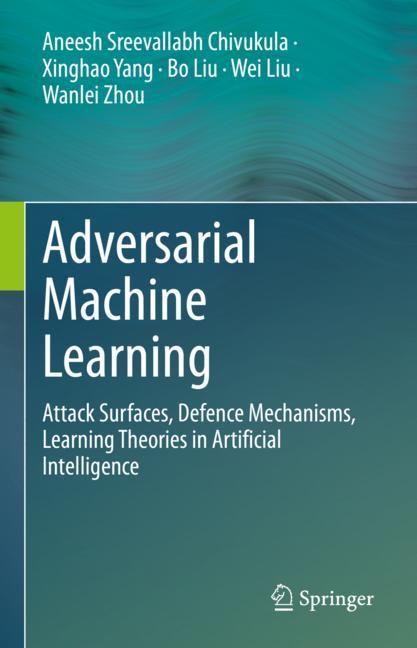
Adversarial Machine Learning
☆☆☆☆☆
(0 opinii)
Najniższa cena (z dostawą)
19 476,00 JPY
Typowa cena4 940,86 PLN
Najniższa (90 dni)101,86 PLN
Liczba ofert1
Ostatnia aktualizacja2 dni temu
| Sprzedawca | Cena produktu | Dostawa | Razem | Dostępność | Aktualizacja | |
|---|---|---|---|---|---|---|
| SP Springer Nature Author | 19 447,00 JPY | 29,00 JPY | 19 476,00 JPY | Dostępny | 2 dni temu | Zobacz ofertę |
Ceny i dostępność mogą ulec zmianie. Ostatnia aktualizacja: 08.08.2026 23:32.
EAN
9783030997724
Springer Nature
0,0
☆☆☆☆☆
0 opinii
5★
0%
4★
0%
3★
0%
2★
0%
1★
0%
Opinie o produkcie
Brak opinii — bądź pierwszy!
A critical challenge in deep learning is the vulnerability of deep learning networks to security attacks from intelligent cyber adversaries. Even innocuous perturbations to the training data can be used to manipulate the behaviour of deep networks in unintended ways. In this book, we review the latest developments in adversarial attack technologies in computer vision; natural language processing; and cybersecurity with regard to multidimensional, textual and image data, sequence data, and temporal data. In turn, we assess the robustness properties of deep learning networks to produce a taxonomy of adversarial examples that characterises the security of learning systems using game theoretical adversarial deep learning algorithms. The state-of-the-art in adversarial perturbation-based privacy protection mechanisms is also reviewed. We propose new adversary types for game theoretical objectives in non-stationary computational learning environments. Proper quantificationof the hypothesis set in the decision problems of our research leads to various functional problems, oracular problems, sampling tasks, and optimization problems. We also address the defence mechanisms currently available for deep learning models deployed in real-world environments. The learning theories used in these defence mechanisms concern data representations, feature manipulations, misclassifications costs, sensitivity landscapes, distributional robustness, and complexity classes of the adversarial deep learning algorithms and their applications. In closing, we propose future research directions in adversarial deep learning applications for resilient learning system design and review formalized learning assumptions concerning the attack surfaces and robustness characteristics of artificial intelligence applications so as to deconstruct the contemporary adversarial deep learning designs. Given its scope, the book will be of interest to Adversarial Machine Learning practitioners and Adversarial Artificial Intelligence researchers whose work involves the design and application of Adversarial Deep Learning.
Podobne produkty
 Gamma Knife Neurosurgery in the Management of Intracranial Disorders
od $210.78
Gamma Knife Neurosurgery in the Management of Intracranial Disorders
od $210.78
 SDGs in Construction Economics and Organization
od $210.78
SDGs in Construction Economics and Organization
od $210.78
 Emerging Therapies in Neurorehabilitation III
od $210.78
Emerging Therapies in Neurorehabilitation III
od $210.78
 Ground Improvement Techniques
od $220.36
Ground Improvement Techniques
od $220.36
 Anomaly Detection in Video Surveillance
od $220.36
Anomaly Detection in Video Surveillance
od $220.36
 Mechanism and Machine Science
od $287.42
Mechanism and Machine Science
od $287.42
 Protein-Protein Interactions as New Drug Targets
od $287.42
Protein-Protein Interactions as New Drug Targets
od $287.42
 Proceedings of the 7th International Conference of Transportation Research Group of India (CTRG 2023
od $287.42
Proceedings of the 7th International Conference of Transportation Research Group of India (CTRG 2023
od $287.42