
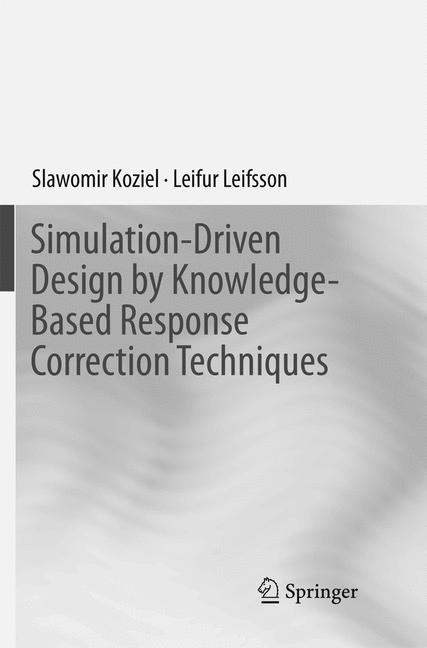
Simulation-Driven Design by Knowledge-Based Response Correction Techniques
☆☆☆☆☆
(0 reviews)
Lowest price (incl. delivery)
7 149,00 JPY
Typical price329,96 PLN
Lowest (90 days)42,79 PLN
Offers2
Last updated1 dag geleden
| Verkoper | Product price | Delivery | Totaal | Beschikbaarheid | Updated | |
|---|---|---|---|---|---|---|
| SP Springer Nature Author | 7 149,00 JPY | free | 7 149,00 JPY | Beschikbaar | 1 dag geleden | View offer |
| SP SpringerNatureLink Shop INT | 59,00 EUR | 19,00 EUR | 78,00 EUR | Beschikbaar | 1 dag geleden | View offer |
Prijzen en beschikbaarheid kunnen wijzigen. Laatst bijgewerkt: 08.08.2026 23:08.
0,0
☆☆☆☆☆
0 reviews
5★
0%
4★
0%
3★
0%
2★
0%
1★
0%
Product reviews
No reviews yet — be the first!
Focused on efficient simulation-driven multi-fidelity optimization techniques, this monograph on simulation-driven optimization covers simulations utilizing physics-based low-fidelity models, often based on coarse-discretization simulations or other types of simplified physics representations, such as analytical models. The methods presented in the book exploit as much as possible any knowledge about the system or device of interest embedded in the low-fidelity model with the purpose of reducing the computational overhead of the design process. Most of the techniques described in the book are of response correction type and can be split into parametric (usually based on analytical formulas) and non-parametric, i.e., not based on analytical formulas. The latter, while more complex in implementation, tend to be more efficient. The book presents a general formulation of response correction techniques as well as a number of specific methods, including those based on correcting the low-fidelity model response (output space mapping, manifold mapping, adaptive response correction and shape-preserving response prediction), as well as on suitable modification of design specifications. Detailed formulations, application examples and the discussion of advantages and disadvantages of these techniques are also included. The book demonstrates the use of the discussed techniques for solving real-world engineering design problems, including applications in microwave engineering, antenna design, and aero/hydrodynamics.
Similar products
 Patient Safety Coaching
from $91.97
Patient Safety Coaching
from $91.97
 Ethnography and Diversity
from $69.30
Ethnography and Diversity
from $69.30
 Smart Villages
from $91.97
Smart Villages
from $91.97
 Nuclear Non-Proliferation in International Law - Volume VI
from $91.97
Nuclear Non-Proliferation in International Law - Volume VI
from $91.97
 The Price of Freedom
from $91.97
The Price of Freedom
from $91.97
 Eco-Social Policy in the OECD and the World Bank
from $91.97
Eco-Social Policy in the OECD and the World Bank
from $91.97
 Special Topics in Policing
from $122.58
Special Topics in Policing
from $122.58
 Music from the Heart
from $91.97
Music from the Heart
from $91.97