
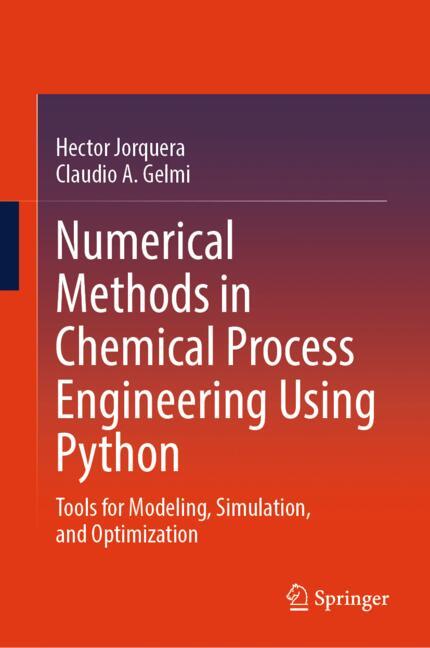
Numerical Methods in Chemical Process Engineering Using Python
☆☆☆☆☆
(0 reviews)
Lowest price (incl. delivery)
100,68 USD
Typical price73,34 PLN
Lowest (90 days)71,68 PLN
Offers5
Last updated9 minuten geleden
| Verkoper | Product price | Delivery | Totaal | Beschikbaarheid | Updated | |
|---|---|---|---|---|---|---|
| SP SpringerNatureLink Shop INT | 71,68 USD | 29,00 USD | 100,68 USD | Beschikbaar | 15 minuten geleden | View offer |
| SP SpringerNatureLink Shop INT | 71,68 USD | 19,00 USD | 90,68 USD | Beschikbaar | 15 minuten geleden | View offer |
| SP SpringerNatureLink Shop INT | 79,99 USD | 15,00 USD | 94,99 USD | Beschikbaar | 1 minuut geleden | View offer |
| SP SpringerNatureLink Shop INT | 79,99 USD | 29,00 USD | 108,99 USD | Beschikbaar | 1 minuut geleden | View offer |
| SP SpringerNatureLink Shop INT | 74,99 GBP | 29,00 GBP | 103,99 GBP | Beschikbaar | 9 minuten geleden | View offer |
Prijzen en beschikbaarheid kunnen wijzigen. Laatst bijgewerkt: 15.08.2026 01:52.
0,0
☆☆☆☆☆
0 reviews
5★
0%
4★
0%
3★
0%
2★
0%
1★
0%
Product reviews
No reviews yet — be the first!
This book provides an overview of the most widely used numerical methods in chemical process engineering organized by increasing levels of complexity. The book begins with numerical linear algebra, which is essential for solving large systems of equations, and continues with nonlinear equations, a cornerstone for modeling equilibrium and reaction kinetics. Ordinary differential equations are then addressed, covering both initial value and boundary value problems, with an emphasis on their role in describing dynamic behavior and transport phenomena. The section concludes with partial differential equations, which are fundamental for capturing spatial and temporal variations in heat, mass, and momentum transfer. The second part of the book presents a curated set of solved problems, each supported by Python code and figures. Covering topics such as parameter estimation, confidence intervals, and bioreactor optimization, the problems emphasize both steady-state and dynamic systems. Each example covers the deriving governing equations, related code, and interpreting results, providing a consistent learning path, while additional discussions encourage students to explore related concepts beyond the presented problem.
Similar products
 Complications Management in Andrologic Surgery
from $100.97
Complications Management in Andrologic Surgery
from $100.97
 Nursing Guide for Pediatric Neuroscience Patients
from $100.97
Nursing Guide for Pediatric Neuroscience Patients
from $100.97
 From Two to Three
from $100.97
From Two to Three
from $100.97
 Gen-Z Talent Management
from $100.97
Gen-Z Talent Management
from $100.97
 Die Innen- und Außenwelt der Volkswirtschaftslehre im Zusammenspiel von Paradigmenmonismus und Perfo
from $85.86
Die Innen- und Außenwelt der Volkswirtschaftslehre im Zusammenspiel von Paradigmenmonismus und Perfo
from $85.86
 Corruption and Democracy
from $100.97
Corruption and Democracy
from $100.97
 Corporate Portfolio Communication
from $100.97
Corporate Portfolio Communication
from $100.97
 Framing im Kontext effizienter Personalführung
from $85.86
Framing im Kontext effizienter Personalführung
from $85.86