
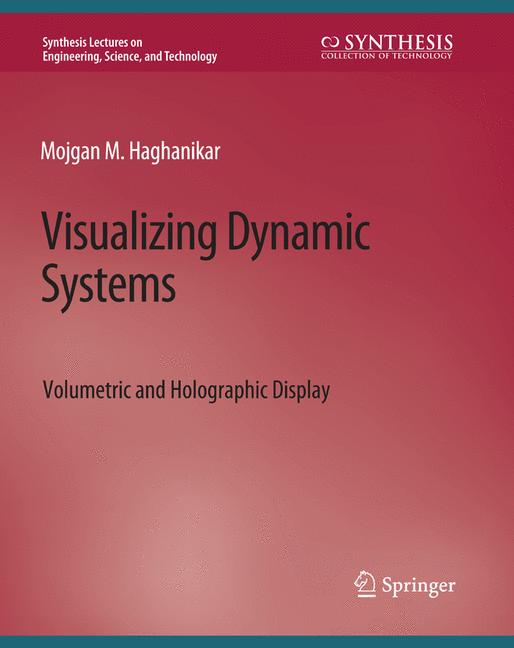
Visualizing Dynamic Systems
☆☆☆☆☆
(0 reviews)
Lowest price (incl. delivery)
4 003,00 JPY
Typical price295,22 PLN
Lowest (90 days)29,11 PLN
Offers2
Last updated14시간 전
| 판매자 | Product price | Delivery | 합계 | 재고 여부 | Updated | |
|---|---|---|---|---|---|---|
| SP Springer Nature Author | 4 003,00 JPY | free | 4 003,00 JPY | 구매 가능 | 14시간 전 | View offer |
| SP SpringerNatureLink Shop INT | 30,79 EUR | 15,00 EUR | 45,79 EUR | 구매 가능 | 1일 전 | View offer |
가격과 재고 여부는 변경될 수 있습니다. 마지막 업데이트: 08.08.2026 23:06.
EAN
9783031009648
Springer Nature
0,0
☆☆☆☆☆
0 reviews
5★
0%
4★
0%
3★
0%
2★
0%
1★
0%
Product reviews
No reviews yet — be the first!
This book is aimed to help instructional designers, science game designers, science faculty, lab designers, and content developers in designing interactive learning experiences using emerging technologies and cyberlearning. The proposed solutions are for undergraduate and graduate scientific communication, engineering courses, scientific research communication, and workforce training. Reviewing across the science education literature reveals various aspects of unresolved challenges or inabilities in the visualization of scientific concepts. Visuospatial thinking is the fundamental part of learning sciences; however, promoting spatial thinking has not been emphasized enough in the educational system (Hegarty, 2014). Cognitive scientists distinguish between the multiple aspects of spatial ability and stresse that various problems or disciplines require different types of spatial skills. For example, the spatial ability to visualize anatomy cross-sections is significantly associated with mental rotation skills. The same is true for physical problems that often deal with spatial representations. However, most of the physics problems are marked by dynamicity, and visualizing dynamicity is inferred by the integrations of different participating components in the system. Therefore, what is needed for learning dynamicity is visualizing the mental animation of static episodes. This book is a leap into designing framework for using mixed reality (XR) technologies and cyberlearning in communicating advanced scientific concepts. The intention is to flesh out the cognitive infrastructure and visuospatial demands of complex systems and compare them in various contexts and disciplines. The practical implementation of emerging technology can be achieved by foreseeing each XR technology’s affordances and mapping those out to the cognitive infrastructure and visuospatial demands of the content under development.
Similar products
 Patient Safety Coaching
from $91.97
Patient Safety Coaching
from $91.97
 Ethnography and Diversity
from $69.30
Ethnography and Diversity
from $69.30
 Smart Villages
from $91.97
Smart Villages
from $91.97
 Nuclear Non-Proliferation in International Law - Volume VI
from $91.97
Nuclear Non-Proliferation in International Law - Volume VI
from $91.97
 The Price of Freedom
from $91.97
The Price of Freedom
from $91.97
 Eco-Social Policy in the OECD and the World Bank
from $91.97
Eco-Social Policy in the OECD and the World Bank
from $91.97
 Special Topics in Policing
from $122.58
Special Topics in Policing
from $122.58
 Music from the Heart
from $91.97
Music from the Heart
from $91.97