
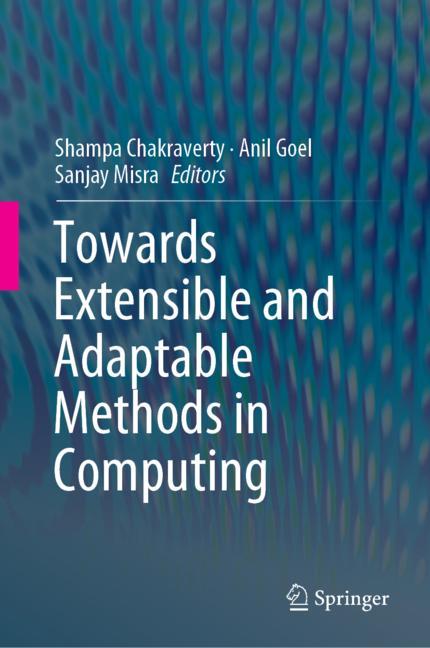
Towards Extensible and Adaptable Methods in Computing
☆☆☆☆☆
(0 reviews)
Lowest price (incl. delivery)
14 318,00 JPY
Typical price1 121,54 PLN
Lowest (90 days)71,50 PLN
Offers6
Last updated1주 전
Price history (90 days)
Full history
2026-08-08
2026-08-15
| 업데이트 일시 | 가격 |
|---|---|
| 2026-08-08 | 84,99 |
| 2026-08-15 | 71,50 |
| 판매자 | Product price | Delivery | 합계 | 재고 여부 | Updated | |
|---|---|---|---|---|---|---|
| SP SpringerNatureLink Shop INT | 14 299,00 JPY | 19,00 JPY | 14 318,00 JPY | 구매 가능 | 4일 전 | View offer |
| SP Springer Nature Author | 14 299,00 JPY | free | 14 299,00 JPY | 구매 가능 | 1주 전 | View offer |
| SP SpringerNatureLink Shop INT | 99,99 USD | free | 99,99 USD | 구매 가능 | 4일 전 | View offer |
| SP SpringerNatureLink Shop INT | 109,99 USD | free | 109,99 USD | 구매 가능 | 4일 전 | View offer |
| SP SpringerNatureLink Shop INT | 109,99 USD | 19,00 USD | 128,99 USD | 구매 가능 | 4일 전 | View offer |
| SP SpringerNatureLink Shop INT | 118,00 EUR | 29,00 EUR | 147,00 EUR | 구매 가능 | 4일 전 | View offer |
가격과 재고 여부는 변경될 수 있습니다. 마지막 업데이트: 08.08.2026 23:21.
0,0
☆☆☆☆☆
0 reviews
5★
0%
4★
0%
3★
0%
2★
0%
1★
0%
Product reviews
No reviews yet — be the first!
This book addresses extensible and adaptable computing, a broad range of methods and techniques used to systematically tackle the future growth of systems and respond proactively and seamlessly to change. The book is divided into five main sections: Agile Software Development, Data Management, Web Intelligence, Machine Learning and Computing in Education. These sub-domains of computing work together in mutually complementary ways to build systems and applications that scale well, and which can successfully meet the demands of changing times and contexts. The topics under each track have been carefully selected to highlight certain qualitative aspects of applications and systems, such as scalability, flexibility, integration, efficiency and context awareness. The first section (Agile Software Development) includes six contributions that address related issues, including risk management, test case prioritization and tools, open source software reliability and predicting the change proneness of software. The second section (Data Management) includes discussions on myriad issues, such as extending database caches using solid-state devices, efficient data transmission, healthcare applications and data security. In turn, the third section (Machine Learning) gathers papers that investigate ML algorithms and present their specific applications such as portfolio optimization, disruption classification and outlier detection. The fourth section (Web Intelligence) covers emerging applications such as metaphor detection, language identification and sentiment analysis, and brings to the fore web security issues such as fraud detection and trust/reputation systems. In closing, the fifth section (Computing in Education) focuses on various aspects of computer-aided pedagogical methods.
Similar products
 50 Years of Philosophy and Medicine
from $107.30
50 Years of Philosophy and Medicine
from $107.30
 Understanding Cybersecurity Law and Digital Privacy
from $122.63
Understanding Cybersecurity Law and Digital Privacy
from $122.63
 Decisions in International Trade and Logistics
from $122.63
Decisions in International Trade and Logistics
from $122.63
 Advances in Economic Measurement
from $122.63
Advances in Economic Measurement
from $122.63
 Nanomaterials
from $137.96
Nanomaterials
from $137.96
 Sustainable Scaffolds-based Strategies in Tissue Engineering and Regenerative Medicine
from $162.87
Sustainable Scaffolds-based Strategies in Tissue Engineering and Regenerative Medicine
from $162.87
 Narratives in Educational Research
from $162.87
Narratives in Educational Research
from $162.87
 Environmental Biology of the Young Chinese Sturgeon
from $210.78
Environmental Biology of the Young Chinese Sturgeon
from $210.78