
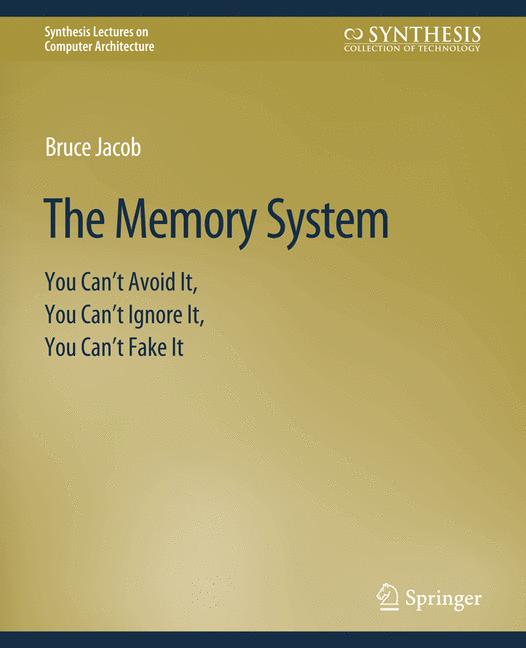
The Memory System
☆☆☆☆☆
(0 reviews)
Lowest price (incl. delivery)
4 028,00 JPY
Typical price26,80 PLN
Lowest (90 days)8,10 PLN
Offers4
Last updated1주 전
Price history (90 days)
Full history
2026-08-07
2026-08-14
| 업데이트 일시 | 가격 |
|---|---|
| 2026-08-07 | 8,10 |
| 2026-08-08 | 26,74 |
| 2026-08-14 | 29,11 |
| 판매자 | Product price | Delivery | 합계 | 재고 여부 | Updated | |
|---|---|---|---|---|---|---|
| SP SpringerNatureLink Shop INT | 4 003,00 JPY | 25,00 JPY | 4 028,00 JPY | 구매 가능 | 1일 전 | View offer |
| SP SpringerNatureLink Shop INT | 30,79 EUR | free | 30,79 EUR | 구매 가능 | 1일 전 | View offer |
| SP Springer Nature Author | 33,50 EUR | free | 33,50 EUR | 구매 가능 | 1주 전 | View offer |
| VI VitalSource | 170,77 ZAR | 15,00 ZAR | 185,77 ZAR | 구매 가능 | 1주 전 | View offer |
가격과 재고 여부는 변경될 수 있습니다. 마지막 업데이트: 08.08.2026 05:05.
EAN
9783031005961
Springer Nature
0,0
☆☆☆☆☆
0 reviews
5★
0%
4★
0%
3★
0%
2★
0%
1★
0%
Product reviews
No reviews yet — be the first!
Today, computer-system optimization, at both the hardware and software levels, must consider the details of the memory system in its analysis; failing to do so yields systems that are increasingly inefficient as those systems become more complex. This lecture seeks to introduce the reader to the most important details of the memory system; it targets both computer scientists and computer engineers in industry and in academia. Roughly speaking, computer scientists are the users of the memory system and computer engineers are the designers of the memory system. Both can benefit tremendously from a basic understanding of how the memory system really works: the computer scientist will be better equipped to create algorithms that perform well and the computer engineer will be better equipped to design systems that approach the optimal, given the resource limitations. Currently, there is consensus among architecture researchers that the memory system is "the bottleneck," and this consensus has held for over a decade. Somewhat inexplicably, most of the research in the field is still directed toward improving the CPU to better tolerate a slow memory system, as opposed to addressing the weaknesses of the memory system directly. This lecture should get the bulk of the computer science and computer engineering population up the steep part of the learning curve. Not every CS/CE researcher/developer needs to do work in the memory system, but, just as a carpenter can do his job more efficiently if he knows a little of architecture, and an architect can do his job more efficiently if he knows a little of carpentry, giving the CS/CE worlds better intuition about the memory system should help them build better systems, both software and hardware. Table of Contents: Primers / It Must Be Modeled Accurately / ...\ and It Will Change Soon
Similar products
 50 Years of Philosophy and Medicine
from $107.30
50 Years of Philosophy and Medicine
from $107.30
 Understanding Cybersecurity Law and Digital Privacy
from $122.63
Understanding Cybersecurity Law and Digital Privacy
from $122.63
 Decisions in International Trade and Logistics
from $122.63
Decisions in International Trade and Logistics
from $122.63
 Advances in Economic Measurement
from $122.63
Advances in Economic Measurement
from $122.63
 Nanomaterials
from $137.96
Nanomaterials
from $137.96
 Sustainable Scaffolds-based Strategies in Tissue Engineering and Regenerative Medicine
from $162.87
Sustainable Scaffolds-based Strategies in Tissue Engineering and Regenerative Medicine
from $162.87
 Narratives in Educational Research
from $162.87
Narratives in Educational Research
from $162.87
 Environmental Biology of the Young Chinese Sturgeon
from $210.78
Environmental Biology of the Young Chinese Sturgeon
from $210.78