
The Hypercycle
☆☆☆☆☆
(0 reviews)
Lowest price (incl. delivery)
148,00 GBP
Typical price159,00 PLN
Lowest (90 days)159,00 PLN
Offers2
Last updated6일 전
| 판매자 | Product price | Delivery | 합계 | 재고 여부 | Updated | |
|---|---|---|---|---|---|---|
| SP SpringerNatureLink Shop INT | 123,00 GBP | 25,00 GBP | 148,00 GBP | 구매 가능 | 8시간 전 | View offer |
| SP Springer Nature Author | 159,00 USD | 29,00 USD | 188,00 USD | 구매 가능 | 6일 전 | View offer |
가격과 재고 여부는 변경될 수 있습니다. 마지막 업데이트: 08.08.2026 22:27.
EAN
9783540092933
Springer Nature
0,0
☆☆☆☆☆
0 reviews
5★
0%
4★
0%
3★
0%
2★
0%
1★
0%
Product reviews
No reviews yet — be the first!
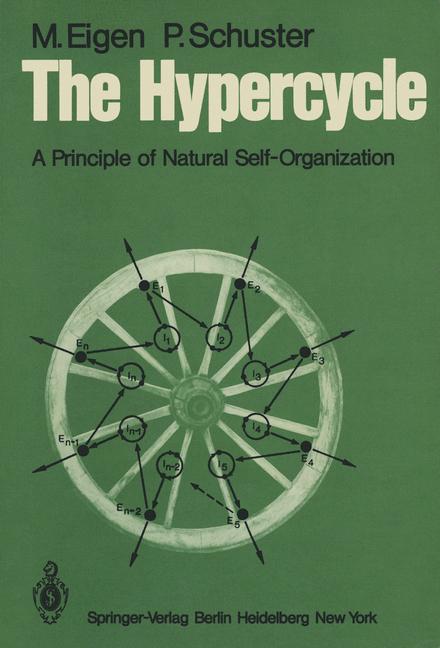
This book originated from a series of papers which were published in "Die Naturwissenschaften" in 1977178. Its division into three parts is the reflection of a logic structure, which may be abstracted in the form of three theses: A. Hypercycles are a principle of natural selforganization allowing an inte gration and coherent evolution of a set of functionally coupled self-rep licative entities. B. Hypercycles are a novel class of nonlinear reaction networks with unique properties, amenable to a unified mathematical treatment. C. Hypercycles are able to originate in the mutant distribution of a single Darwinian quasi-species through stabilization of its diverging mutant genes. Once nucleated hypercycles evolve to higher complexity by a process analogous to gene duplication and specialization. In order to outline the meaning of the first statement we may refer to another principle of material selforganization, namely to Darwin's principle of natural selection. This principle as we see it today represents the only understood means for creating information, be it the blue print for a complex living organism which evolved from less complex ancestral forms, or be it a meaningful sequence of letters the selection of which can be simulated by evolutionary model games.
Similar products
 50 Years of Philosophy and Medicine
from $107.30
50 Years of Philosophy and Medicine
from $107.30
 Understanding Cybersecurity Law and Digital Privacy
from $122.63
Understanding Cybersecurity Law and Digital Privacy
from $122.63
 Decisions in International Trade and Logistics
from $122.63
Decisions in International Trade and Logistics
from $122.63
 Advances in Economic Measurement
from $122.63
Advances in Economic Measurement
from $122.63
 Nanomaterials
from $137.96
Nanomaterials
from $137.96
 Sustainable Scaffolds-based Strategies in Tissue Engineering and Regenerative Medicine
from $162.87
Sustainable Scaffolds-based Strategies in Tissue Engineering and Regenerative Medicine
from $162.87
 Narratives in Educational Research
from $162.87
Narratives in Educational Research
from $162.87
 Environmental Biology of the Young Chinese Sturgeon
from $210.78
Environmental Biology of the Young Chinese Sturgeon
from $210.78