
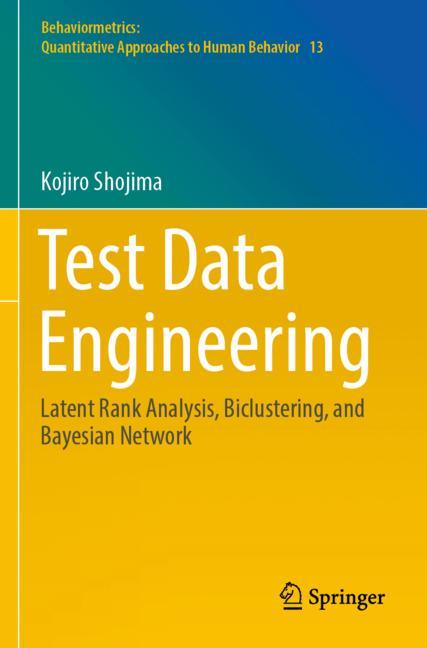
Test Data Engineering
☆☆☆☆☆
(0 reviews)
Lowest price (incl. delivery)
20 019,00 JPY
Typical price2 613,37 PLN
Lowest (90 days)82,38 PLN
Offers1
Last updated1일 전
| 판매자 | Product price | Delivery | 합계 | 재고 여부 | Updated | |
|---|---|---|---|---|---|---|
| SP Springer Nature Author | 20 019,00 JPY | free | 20 019,00 JPY | 구매 가능 | 1일 전 | View offer |
가격과 재고 여부는 변경될 수 있습니다. 마지막 업데이트: 08.08.2026 22:24.
0,0
☆☆☆☆☆
0 reviews
5★
0%
4★
0%
3★
0%
2★
0%
1★
0%
Product reviews
No reviews yet — be the first!
This is the first technical book that considers tests as public tools and examines how to engineer and process test data, extract the structure within the data to be visualized, and thereby make test results useful for students, teachers, and the society. The author does not differentiate test data analysis from data engineering and information visualization. This monograph introduces the following methods of engineering or processing test data, including the latest machine learning techniques: classical test theory (CTT), item response theory (IRT), latent class analysis (LCA), latent rank analysis (LRA), biclustering (co-clustering), and Bayesian network model (BNM). CTT and IRT are methods for analyzing test data and evaluating students’ abilities on a continuous scale. LCA and LRA assess examinees by classifying them into nominal and ordinal clusters, respectively, where the adequate number of clusters is estimated from the data. Biclustering classifies examinees into groups (latent clusters) while classifying items into fields (factors). Particularly, the infinite relational model discussed in this book is a biclustering method feasible under the condition that neither the number of groups nor the number of fields is known beforehand. Additionally, the local dependence LRA, local dependence biclustering, and bicluster network model are methods that search and visualize inter-item (or inter-field) network structure using the mechanism of BNM. As this book offers a new perspective on test data analysis methods, it is certain to widen readers’ perspective on test data analysis.
Similar products
 Gamma Knife Neurosurgery in the Management of Intracranial Disorders
from $210.78
Gamma Knife Neurosurgery in the Management of Intracranial Disorders
from $210.78
 SDGs in Construction Economics and Organization
from $210.78
SDGs in Construction Economics and Organization
from $210.78
 Emerging Therapies in Neurorehabilitation III
from $210.78
Emerging Therapies in Neurorehabilitation III
from $210.78
 Ground Improvement Techniques
from $220.36
Ground Improvement Techniques
from $220.36
 Anomaly Detection in Video Surveillance
from $220.36
Anomaly Detection in Video Surveillance
from $220.36
 Mechanism and Machine Science
from $287.42
Mechanism and Machine Science
from $287.42
 Protein-Protein Interactions as New Drug Targets
from $287.42
Protein-Protein Interactions as New Drug Targets
from $287.42
 Proceedings of the 7th International Conference of Transportation Research Group of India (CTRG 2023
from $287.42
Proceedings of the 7th International Conference of Transportation Research Group of India (CTRG 2023
from $287.42