
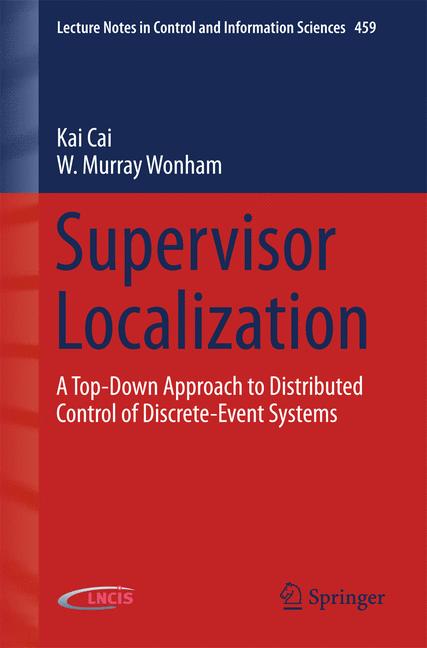
Supervisor Localization
☆☆☆☆☆
(0 reviews)
Lowest price (incl. delivery)
7 164,00 JPY
Typical price314,07 PLN
Lowest (90 days)39,99 PLN
Offers2
Last updated5시간 전
| 판매자 | Product price | Delivery | 합계 | 재고 여부 | Updated | |
|---|---|---|---|---|---|---|
| SP Springer Nature Author | 7 149,00 JPY | 15,00 JPY | 7 164,00 JPY | 구매 가능 | 5시간 전 | View offer |
| SP SpringerNatureLink Shop INT | 59,00 EUR | free | 59,00 EUR | 구매 가능 | 17시간 전 | View offer |
가격과 재고 여부는 변경될 수 있습니다. 마지막 업데이트: 08.08.2026 23:08.
0,0
☆☆☆☆☆
0 reviews
5★
0%
4★
0%
3★
0%
2★
0%
1★
0%
Product reviews
No reviews yet — be the first!
This monograph presents a systematic top-down approach to distributed control synthesis of discrete-event systems (DES). The approach is called supervisor localization; its essence is the allocation of external supervisory control action to individual component agents as their internal control strategies. The procedure is: first synthesize a monolithic supervisor, to achieve globally optimal and nonblocking controlled behavior, then decompose the monolithic supervisor into local controllers, one for each agent. The collective behavior of the resulting local controllers is identical to that achieved by the monolithic supervisor. The basic localization theory is first presented in the Ramadge–Wonham language-based supervisory control framework, then demonstrated with distributed control examples of multi-robot formations, manufacturing systems, and distributed algorithms. An architectural approach is adopted to apply localization to large-scale DES; this yields a heterarchical localization procedure, which is also demonstrated with benchmark examples. Moreover, a state-based framework, state-tree structures, is exploited for efficient computation of localization. Finally localization is extended to timed DES, which addresses distributed control synthesis with temporal specifications. The authors’ TCT software and sourcecode will help the reader to reproduce the results demonstrated in the examples. Academic researchers and graduate students interested in discrete-event and distributed systems and control will find this book an instructive resource. It will also be useful for researchers in manufacturing, supply-chain and logistics and practitioners in related industries.
Similar products
 Patient Safety Coaching
from $91.97
Patient Safety Coaching
from $91.97
 Ethnography and Diversity
from $69.30
Ethnography and Diversity
from $69.30
 Smart Villages
from $91.97
Smart Villages
from $91.97
 Nuclear Non-Proliferation in International Law - Volume VI
from $91.97
Nuclear Non-Proliferation in International Law - Volume VI
from $91.97
 The Price of Freedom
from $91.97
The Price of Freedom
from $91.97
 Eco-Social Policy in the OECD and the World Bank
from $91.97
Eco-Social Policy in the OECD and the World Bank
from $91.97
 Special Topics in Policing
from $122.58
Special Topics in Policing
from $122.58
 Music from the Heart
from $91.97
Music from the Heart
from $91.97