
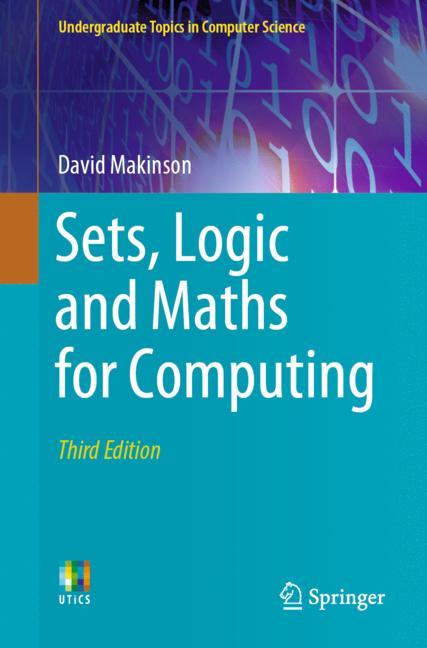
Sets, Logic and Maths for Computing
☆☆☆☆☆
(0 reviews)
Lowest price (incl. delivery)
5 719,00 JPY
Typical price128,72 PLN
Lowest (90 days)25,19 PLN
Offers2
Last updated1일 전
| 판매자 | Product price | Delivery | 합계 | 재고 여부 | Updated | |
|---|---|---|---|---|---|---|
| SP Springer Nature Author | 5 719,00 JPY | free | 5 719,00 JPY | 구매 가능 | 13시간 전 | View offer |
| SP SpringerNatureLink Shop INT | 41,99 USD | 15,00 USD | 56,99 USD | 구매 가능 | 1일 전 | View offer |
가격과 재고 여부는 변경될 수 있습니다. 마지막 업데이트: 08.08.2026 11:14.
0,0
☆☆☆☆☆
0 reviews
5★
0%
4★
0%
3★
0%
2★
0%
1★
0%
Product reviews
No reviews yet — be the first!
This easy-to-understand textbook introduces the mathematical language and problem-solving tools essential to anyone wishing to enter the world of computer and information sciences. Specifically designed for the student who is intimidated by mathematics, the book offers a concise treatment in an engaging style. The thoroughly revised third edition features a new chapter on relevance-sensitivity in logical reasoning and many additional explanations on points that students find puzzling, including the rationale for various shorthand ways of speaking and ‘abuses of language’ that are convenient but can give rise to misunderstandings. Solutions are now also provided for all exercises. Topics and features: presents an intuitive approach, emphasizing how finite mathematics supplies a valuable language for thinking about computation; discusses sets and the mathematical objects built with them, such as relations and functions, as well as recursion and induction; introduces core topics of mathematics, including combinatorics and finite probability, along with the structures known as trees; examines propositional and quantificational logic, how to build complex proofs from simple ones, and how to ensure relevance in logic; addresses questions that students find puzzling but may have difficulty articulating, through entertaining conversations between Alice and the Mad Hatter; provides an extensive set of solved exercises throughout the text. This clearly-written textbook offers invaluable guidance to students beginning an undergraduate degree in computer science. The coverage is also suitable for courses on formal methods offered to those studying mathematics, philosophy, linguistics, economics, and political science. Assuming only minimal mathematical background, it is ideal for both the classroom and independent study.
Similar products
 Patient Safety Coaching
from $91.97
Patient Safety Coaching
from $91.97
 Ethnography and Diversity
from $69.30
Ethnography and Diversity
from $69.30
 Smart Villages
from $91.97
Smart Villages
from $91.97
 Nuclear Non-Proliferation in International Law - Volume VI
from $91.97
Nuclear Non-Proliferation in International Law - Volume VI
from $91.97
 The Price of Freedom
from $91.97
The Price of Freedom
from $91.97
 Eco-Social Policy in the OECD and the World Bank
from $91.97
Eco-Social Policy in the OECD and the World Bank
from $91.97
 Special Topics in Policing
from $122.58
Special Topics in Policing
from $122.58
 Music from the Heart
from $91.97
Music from the Heart
from $91.97