
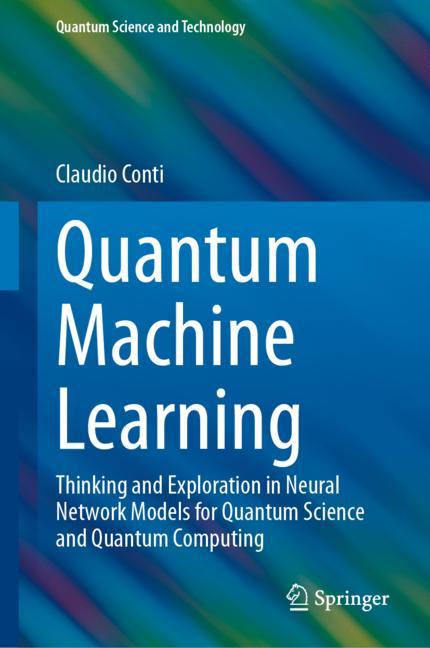
Quantum Machine Learning
☆☆☆☆☆
(0 reviews)
Lowest price (incl. delivery)
110,75 EUR
Typical price85,75 PLN
Lowest (90 days)85,75 PLN
Offers1
Last updated2일 전
| 판매자 | Product price | Delivery | 합계 | 재고 여부 | Updated | |
|---|---|---|---|---|---|---|
| SP Springer Nature Author | 85,75 EUR | 25,00 EUR | 110,75 EUR | 구매 가능 | 2일 전 | View offer |
가격과 재고 여부는 변경될 수 있습니다. 마지막 업데이트: 08.08.2026 22:04.
EAN
9783031442261
Springer Nature
0,0
☆☆☆☆☆
0 reviews
5★
0%
4★
0%
3★
0%
2★
0%
1★
0%
Product reviews
No reviews yet — be the first!
This book presents a new way of thinking about quantum mechanics and machine learning by merging the two. Quantum mechanics and machine learning may seem theoretically disparate, but their link becomes clear through the density matrix operator which can be readily approximated by neural network models, permitting a formulation of quantum physics in which physical observables can be computed via neural networks. As well as demonstrating the natural affinity of quantum physics and machine learning, this viewpoint opens rich possibilities in terms of computation, efficient hardware, and scalability. One can also obtain trainable models to optimize applications and fine-tune theories, such as approximation of the ground state in many body systems, and boosting quantum circuits’ performance. The book begins with the introduction of programming tools and basic concepts of machine learning, with necessary background material from quantum mechanics and quantum information also provided. This enables the basic building blocks, neural network models for vacuum states, to be introduced. The highlights that follow include: non-classical state representations, with squeezers and beam splitters used to implement the primary layers for quantum computing; boson sampling with neural network models; an overview of available quantum computing platforms, their models, and their programming; and neural network models as a variational ansatz for many-body Hamiltonian ground states with applications to Ising machines and solitons. The book emphasizes coding, with many open source examples in Python and TensorFlow, while MATLAB and Mathematica routines clarify and validate proofs. This book is essential reading for graduate students and researchers who want to develop both the requisite physics and coding knowledge to understand the rich interplay of quantum mechanics and machine learning.
Similar products
 Gamma Knife Neurosurgery in the Management of Intracranial Disorders
from $210.78
Gamma Knife Neurosurgery in the Management of Intracranial Disorders
from $210.78
 SDGs in Construction Economics and Organization
from $210.78
SDGs in Construction Economics and Organization
from $210.78
 Emerging Therapies in Neurorehabilitation III
from $210.78
Emerging Therapies in Neurorehabilitation III
from $210.78
 Ground Improvement Techniques
from $220.36
Ground Improvement Techniques
from $220.36
 Anomaly Detection in Video Surveillance
from $220.36
Anomaly Detection in Video Surveillance
from $220.36
 Mechanism and Machine Science
from $287.42
Mechanism and Machine Science
from $287.42
 Protein-Protein Interactions as New Drug Targets
from $287.42
Protein-Protein Interactions as New Drug Targets
from $287.42
 Proceedings of the 7th International Conference of Transportation Research Group of India (CTRG 2023
from $287.42
Proceedings of the 7th International Conference of Transportation Research Group of India (CTRG 2023
from $287.42