
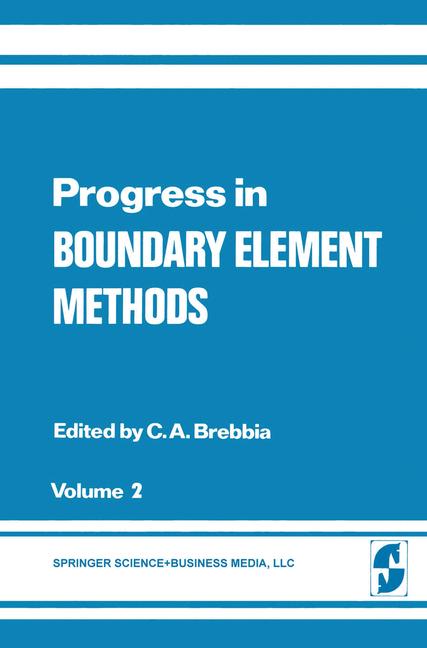
Progress in Boundary Element Methods
☆☆☆☆☆
(0 reviews)
Lowest price (incl. delivery)
7 149,00 JPY
Typical price449,45 PLN
Lowest (90 days)44,99 PLN
Offers6
Last updated1주 전
Price history (90 days)
Full history
2026-08-08
2026-08-15
| 업데이트 일시 | 가격 |
|---|---|
| 2026-08-08 | 49,99 |
| 2026-08-14 | 44,99 |
| 2026-08-15 | 51,99 |
| 판매자 | Product price | Delivery | 합계 | 재고 여부 | Updated | |
|---|---|---|---|---|---|---|
| SP SpringerNatureLink Shop INT | 7 149,00 JPY | free | 7 149,00 JPY | 구매 가능 | 3일 전 | View offer |
| SP Springer Nature Author | 7 149,00 JPY | 25,00 JPY | 7 174,00 JPY | 구매 가능 | 1주 전 | View offer |
| SP SpringerNatureLink Shop INT | 49,99 USD | 15,00 USD | 64,99 USD | 구매 가능 | 4일 전 | View offer |
| SP SpringerNatureLink Shop INT | 54,99 USD | 19,00 USD | 73,99 USD | 구매 가능 | 4일 전 | View offer |
| SP SpringerNatureLink Shop INT | 54,99 USD | free | 54,99 USD | 구매 가능 | 4일 전 | View offer |
| SP SpringerNatureLink Shop INT | 59,00 EUR | 15,00 EUR | 74,00 EUR | 구매 가능 | 3일 전 | View offer |
가격과 재고 여부는 변경될 수 있습니다. 마지막 업데이트: 08.08.2026 23:12.
0,0
☆☆☆☆☆
0 reviews
5★
0%
4★
0%
3★
0%
2★
0%
1★
0%
Product reviews
No reviews yet — be the first!
A substantial amount of research on Boundary Elements has taken place since publication of the first Volume of this series. Most of the new work has concentrated on the solution of non-linear and time dependent problems and the development of numerical techniques to increase the efficiency of the method. Chapter 1 of this Volume deals with the solution of non-linear potential problems, for which the diffusivity coefficient is a function of the potential and the boundary conditions are also non-linear. The recent research reported here opens the way for the solution of a: large range of non-homogeneous problems by using a simple transformation which linearizes the governing equations and consequently does not require the use of internal cells. Chapter 2 summarizes the main integral equations for the solution of two-and three dimensional scalar wave propagation problems. This is a type of problem that is well suited to boundary elements but generally gives poor results when solved using finite elements. The problem of fracture mechanics is studied in Chapter 3, where the ad vantages of using boundary integral equations are demonstrated. One of the most interesting features of BEM i~ the possibility of describing the problem only as a function of the boundary unknowns, even in the presence of body, centrifugal and temperature induced forces. Chapter 4 explains how this can be done for two-and three-dimensional elastostatic problems.
Similar products
 50 Years of Philosophy and Medicine
from $107.30
50 Years of Philosophy and Medicine
from $107.30
 Understanding Cybersecurity Law and Digital Privacy
from $122.63
Understanding Cybersecurity Law and Digital Privacy
from $122.63
 Decisions in International Trade and Logistics
from $122.63
Decisions in International Trade and Logistics
from $122.63
 Advances in Economic Measurement
from $122.63
Advances in Economic Measurement
from $122.63
 Nanomaterials
from $137.96
Nanomaterials
from $137.96
 Sustainable Scaffolds-based Strategies in Tissue Engineering and Regenerative Medicine
from $162.87
Sustainable Scaffolds-based Strategies in Tissue Engineering and Regenerative Medicine
from $162.87
 Narratives in Educational Research
from $162.87
Narratives in Educational Research
from $162.87
 Environmental Biology of the Young Chinese Sturgeon
from $210.78
Environmental Biology of the Young Chinese Sturgeon
from $210.78