
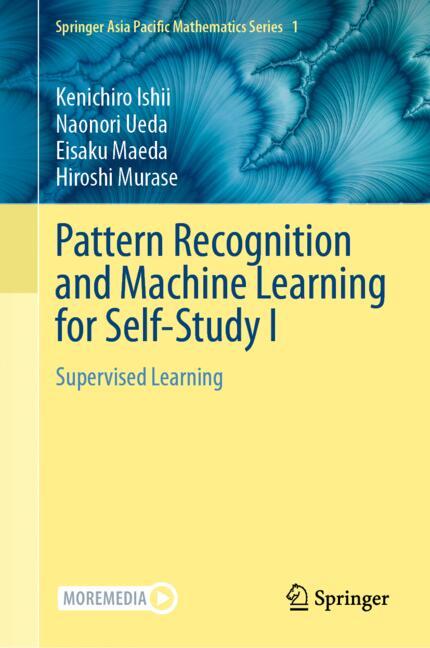
Pattern Recognition and Machine Learning for Self-Study I
☆☆☆☆☆
(0 reviews)
Lowest price (incl. delivery)
8 032,00 JPY
Typical price1 386,50 PLN
Lowest (90 days)47,99 PLN
Offers3
Last updated1주 전
Price history (90 days)
Full history
2026-08-08
2026-08-15
| 업데이트 일시 | 가격 |
|---|---|
| 2026-08-08 | 47,99 |
| 2026-08-15 | 66,00 |
| 판매자 | Product price | Delivery | 합계 | 재고 여부 | Updated | |
|---|---|---|---|---|---|---|
| SP SpringerNatureLink Shop INT | 8 007,00 JPY | 25,00 JPY | 8 032,00 JPY | 구매 가능 | 4일 전 | View offer |
| SP Springer Nature Author | 8 007,00 JPY | free | 8 007,00 JPY | 구매 가능 | 1주 전 | View offer |
| SP SpringerNatureLink Shop INT | 66,00 EUR | 19,00 EUR | 85,00 EUR | 구매 가능 | 4일 전 | View offer |
가격과 재고 여부는 변경될 수 있습니다. 마지막 업데이트: 08.08.2026 23:17.
EAN
9789819514786
Springer Nature
0,0
☆☆☆☆☆
0 reviews
5★
0%
4★
0%
3★
0%
2★
0%
1★
0%
Product reviews
No reviews yet — be the first!
This book explains the basic principles of pattern recognition (PR) and machine learning (ML) in an easy-to-understand manner for beginners who are trying to learn these principles on their own. Readers with a basic knowledge of linear algebra and probability theory will find it easy to follow. Many excellent books in this field have been published in the past. However, these books are not necessarily intended for self-study by beginners. This book limits the topics to the minimum essential themes that beginners should learn, and explains them in detail. This book focuses on supervised learning, first introducing classical but important methods that have contributed to the development of the field. It then explains various methods that have since attracted attention. In explaining these methods, the book also provides a historical account of how new technologies were created as a result of combining classical ideas. The book emphasizes that Bayes decision rule is a fundamental concept in PR and ML. The following points make this book suitable for self-study by beginners. (1) The book is self-contained, so that the reader does not need to refer to other books or literature. (2) To deepen the reader's understanding, exercises are provided at the end of each chapter with detailed solutions available online. (3) To promote the reader's intuitive understanding, the book presents as many concrete examples as possible. (4) ‘Coffee Break’ columns introduce knowledge and know-how from the author's experience. Unsupervised learning will be discussed in a sequel.
Similar products
 50 Years of Philosophy and Medicine
from $107.30
50 Years of Philosophy and Medicine
from $107.30
 Understanding Cybersecurity Law and Digital Privacy
from $122.63
Understanding Cybersecurity Law and Digital Privacy
from $122.63
 Decisions in International Trade and Logistics
from $122.63
Decisions in International Trade and Logistics
from $122.63
 Advances in Economic Measurement
from $122.63
Advances in Economic Measurement
from $122.63
 Nanomaterials
from $137.96
Nanomaterials
from $137.96
 Sustainable Scaffolds-based Strategies in Tissue Engineering and Regenerative Medicine
from $162.87
Sustainable Scaffolds-based Strategies in Tissue Engineering and Regenerative Medicine
from $162.87
 Narratives in Educational Research
from $162.87
Narratives in Educational Research
from $162.87
 Environmental Biology of the Young Chinese Sturgeon
from $210.78
Environmental Biology of the Young Chinese Sturgeon
from $210.78