
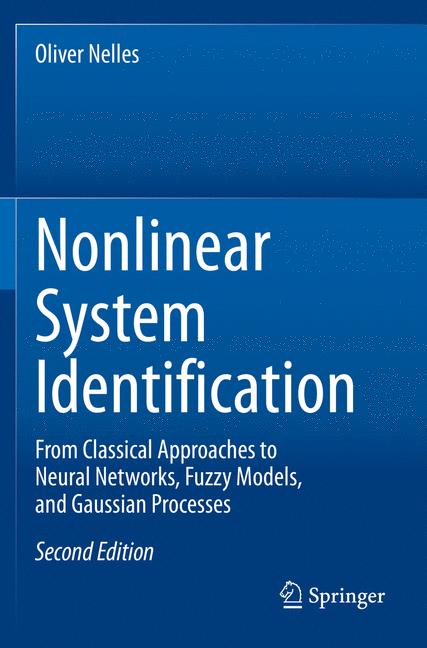
Nonlinear System Identification
☆☆☆☆☆
(0 reviews)
Lowest price (incl. delivery)
58,10 EUR
Typical price690,87 PLN
Lowest (90 days)58,10 PLN
Offers3
Last updated1주 전
Price history (90 days)
Full history
2026-08-08
2026-08-15
| 업데이트 일시 | 가격 |
|---|---|
| 2026-08-08 | 58,10 |
| 2026-08-15 | 58,10 |
| 판매자 | Product price | Delivery | 합계 | 재고 여부 | Updated | |
|---|---|---|---|---|---|---|
| SP SpringerNatureLink Shop INT | 58,10 EUR | free | 58,10 EUR | 구매 가능 | 5일 전 | View offer |
| SP SpringerNatureLink Shop INT | 10 009,00 JPY | 25,00 JPY | 10 034,00 JPY | 구매 가능 | 5일 전 | View offer |
| SP Springer Nature Author | 10 009,00 JPY | 15,00 JPY | 10 024,00 JPY | 구매 가능 | 1주 전 | View offer |
가격과 재고 여부는 변경될 수 있습니다. 마지막 업데이트: 08.08.2026 21:18.
EAN
9783030474416
Springer Nature
0,0
☆☆☆☆☆
0 reviews
5★
0%
4★
0%
3★
0%
2★
0%
1★
0%
Product reviews
No reviews yet — be the first!
This book provides engineers and scientists in academia and industry with a thorough understanding of the underlying principles of nonlinear system identification. It equips them to apply the models and methods discussed to real problems with confidence, while also making them aware of potential difficulties that may arise in practice. Moreover, the book is self-contained, requiring only a basic grasp of matrix algebra, signals and systems, and statistics. Accordingly, it can also serve as an introduction to linear system identification, and provides a practical overview of the major optimization methods used in engineering. The focus is on gaining an intuitive understanding of the subject and the practical application of the techniques discussed. The book is not written in a theorem/proof style; instead, the mathematics is kept to a minimum, and the ideas covered are illustrated with numerous figures, examples, and real-world applications. In the past, nonlinear system identification was a field characterized by a variety of ad-hoc approaches, each applicable only to a very limited class of systems. With the advent of neural networks, fuzzy models, Gaussian process models, and modern structure optimization techniques, a much broader class of systems can now be handled. Although one major aspect of nonlinear systems is that virtually every one is unique, tools have since been developed that allow each approach to be applied to a wide variety of systems.
Similar products
 50 Years of Philosophy and Medicine
from $107.30
50 Years of Philosophy and Medicine
from $107.30
 Understanding Cybersecurity Law and Digital Privacy
from $122.63
Understanding Cybersecurity Law and Digital Privacy
from $122.63
 Decisions in International Trade and Logistics
from $122.63
Decisions in International Trade and Logistics
from $122.63
 Advances in Economic Measurement
from $122.63
Advances in Economic Measurement
from $122.63
 Nanomaterials
from $137.96
Nanomaterials
from $137.96
 Sustainable Scaffolds-based Strategies in Tissue Engineering and Regenerative Medicine
from $162.87
Sustainable Scaffolds-based Strategies in Tissue Engineering and Regenerative Medicine
from $162.87
 Narratives in Educational Research
from $162.87
Narratives in Educational Research
from $162.87
 Environmental Biology of the Young Chinese Sturgeon
from $210.78
Environmental Biology of the Young Chinese Sturgeon
from $210.78