
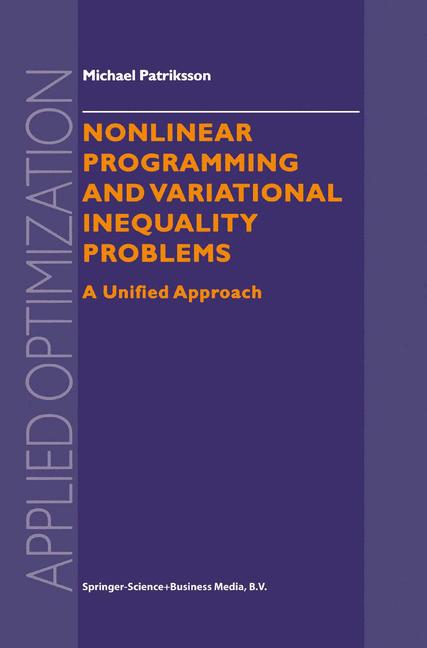
Nonlinear Programming and Variational Inequality Problems
☆☆☆☆☆
(0 reviews)
Lowest price (incl. delivery)
21 468,00 JPY
Typical price2 982,30 PLN
Lowest (90 days)129,99 PLN
Offers6
Last updated1주 전
Price history (90 days)
Full history
2026-08-08
2026-08-15
| 업데이트 일시 | 가격 |
|---|---|
| 2026-08-08 | 129,99 |
| 2026-08-15 | 155,99 |
| 판매자 | Product price | Delivery | 합계 | 재고 여부 | Updated | |
|---|---|---|---|---|---|---|
| SP SpringerNatureLink Shop INT | 21 449,00 JPY | 19,00 JPY | 21 468,00 JPY | 구매 가능 | 2일 전 | View offer |
| SP Springer Nature Author | 21 449,00 JPY | free | 21 449,00 JPY | 구매 가능 | 1주 전 | View offer |
| SP SpringerNatureLink Shop INT | 149,99 USD | free | 149,99 USD | 구매 가능 | 2일 전 | View offer |
| SP SpringerNatureLink Shop INT | 169,99 USD | 25,00 USD | 194,99 USD | 구매 가능 | 2일 전 | View offer |
| SP SpringerNatureLink Shop INT | 169,99 USD | 19,00 USD | 188,99 USD | 구매 가능 | 2일 전 | View offer |
| SP SpringerNatureLink Shop INT | 177,00 EUR | free | 177,00 EUR | 구매 가능 | 2일 전 | View offer |
가격과 재고 여부는 변경될 수 있습니다. 마지막 업데이트: 08.08.2026 23:33.
0,0
☆☆☆☆☆
0 reviews
5★
0%
4★
0%
3★
0%
2★
0%
1★
0%
Product reviews
No reviews yet — be the first!
Since I started working in the area of nonlinear programming and, later on, variational inequality problems, I have frequently been surprised to find that many algorithms, however scattered in numerous journals, monographs and books, and described rather differently, are closely related to each other. This book is meant to help the reader understand and relate algorithms to each other in some intuitive fashion, and represents, in this respect, a consolidation of the field. The framework of algorithms presented in this book is called Cost Approxi mation. (The preface of the Ph.D. thesis [Pat93d] explains the background to the work that lead to the thesis, and ultimately to this book.) It describes, for a given formulation of a variational inequality or nonlinear programming problem, an algorithm by means of approximating mappings and problems, a principle for the update of the iteration points, and a merit function which guides and monitors the convergence of the algorithm. One purpose of this book is to offer this framework as an intuitively appeal ing tool for describing an algorithm. One of the advantages of the framework, or any reasonable framework for that matter, is that two algorithms may be easily related and compared through its use. This framework is particular in that it covers a vast number of methods, while still being fairly detailed; the level of abstraction is in fact the same as that of the original problem statement.
Similar products
 50 Years of Philosophy and Medicine
from $107.30
50 Years of Philosophy and Medicine
from $107.30
 Understanding Cybersecurity Law and Digital Privacy
from $122.63
Understanding Cybersecurity Law and Digital Privacy
from $122.63
 Decisions in International Trade and Logistics
from $122.63
Decisions in International Trade and Logistics
from $122.63
 Advances in Economic Measurement
from $122.63
Advances in Economic Measurement
from $122.63
 Nanomaterials
from $137.96
Nanomaterials
from $137.96
 Sustainable Scaffolds-based Strategies in Tissue Engineering and Regenerative Medicine
from $162.87
Sustainable Scaffolds-based Strategies in Tissue Engineering and Regenerative Medicine
from $162.87
 Narratives in Educational Research
from $162.87
Narratives in Educational Research
from $162.87
 Environmental Biology of the Young Chinese Sturgeon
from $210.78
Environmental Biology of the Young Chinese Sturgeon
from $210.78