
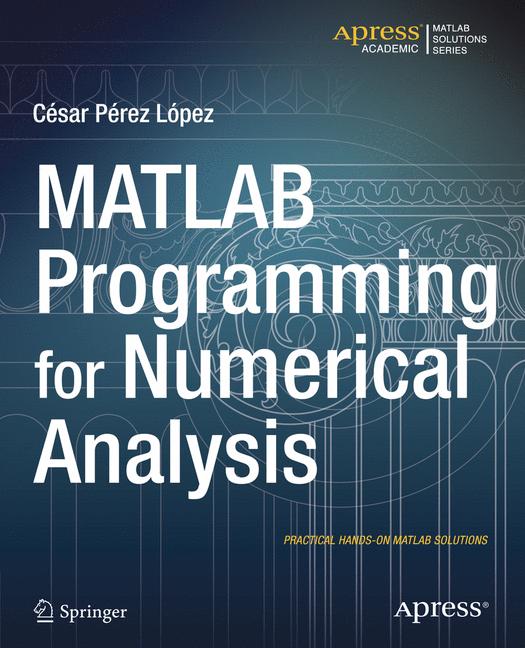
MATLAB Programming for Numerical Analysis
☆☆☆☆☆
(0 reviews)
Lowest price (incl. delivery)
7 164,00 JPY
Typical price361,11 PLN
Lowest (90 days)49,99 PLN
Offers2
Last updated10시간 전
| 판매자 | Product price | Delivery | 합계 | 재고 여부 | Updated | |
|---|---|---|---|---|---|---|
| SP Springer Nature Author | 7 149,00 JPY | 15,00 JPY | 7 164,00 JPY | 구매 가능 | 10시간 전 | View offer |
| SP SpringerNatureLink Shop INT | 59,00 EUR | 25,00 EUR | 84,00 EUR | 구매 가능 | 22시간 전 | View offer |
가격과 재고 여부는 변경될 수 있습니다. 마지막 업데이트: 08.08.2026 23:12.
0,0
☆☆☆☆☆
0 reviews
5★
0%
4★
0%
3★
0%
2★
0%
1★
0%
Product reviews
No reviews yet — be the first!
MATLAB is a high-level language and environment for numerical computation, visualization, and programming. Using MATLAB, you can analyze data, develop algorithms, and create models and applications. The language, tools, and built-in math functions enable you to explore multiple approaches and reach a solution faster than with spreadsheets or traditional programming languages, such as C/C++ or Java. Programming MATLAB for Numerical Analysis introduces you to the MATLAB language with practical hands-on instructions and results, allowing you to quickly achieve your goals. You will first become familiar with the MATLAB environment, and then you will begin to harness the power of MATLAB. You will learn the MATLAB language, starting with an introduction to variables, and how to manipulate numbers, vectors, matrices, arrays and character strings. You will learn about MATLAB’s high-precision capabilities, and how you can use MATLAB to solve problems, making use of arithmetic, relational and logical operators in combination with the common functions and operations of real and complex analysis and linear algebra. You will learn to implement various numerical methods for optimization, interpolation and solving non-linear equations. You will discover how MATLAB can solve problems in differential and integral calculus, both numerically and symbolically, including techniques for solving ordinary and partial differential equations, and how to graph the solutions in brilliant high resolution. You will then expand your knowledge of the MATLAB language by learning how to use commands which enable you to investigate the convergence of sequences and series, and explore continuity and other analytical features of functions in one and several variables.
Similar products
 Patient Safety Coaching
from $91.97
Patient Safety Coaching
from $91.97
 Ethnography and Diversity
from $69.30
Ethnography and Diversity
from $69.30
 Smart Villages
from $91.97
Smart Villages
from $91.97
 Nuclear Non-Proliferation in International Law - Volume VI
from $91.97
Nuclear Non-Proliferation in International Law - Volume VI
from $91.97
 The Price of Freedom
from $91.97
The Price of Freedom
from $91.97
 Eco-Social Policy in the OECD and the World Bank
from $91.97
Eco-Social Policy in the OECD and the World Bank
from $91.97
 Special Topics in Policing
from $122.58
Special Topics in Policing
from $122.58
 Music from the Heart
from $91.97
Music from the Heart
from $91.97