
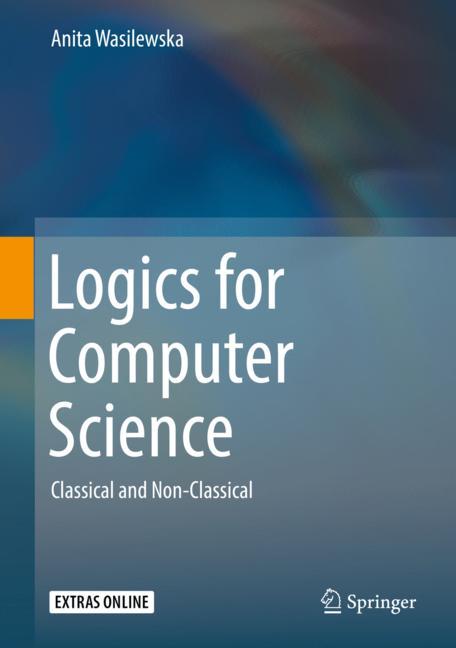
Logics for Computer Science
☆☆☆☆☆
(0 reviews)
Lowest price (incl. delivery)
14 871,00 JPY
Typical price7 496,75 PLN
Lowest (90 days)122,50 PLN
Offers1
Last updated1주 전
| 판매자 | Product price | Delivery | 합계 | 재고 여부 | Updated | |
|---|---|---|---|---|---|---|
| SP Springer Nature Author | 14 871,00 JPY | free | 14 871,00 JPY | 구매 가능 | 1주 전 | View offer |
가격과 재고 여부는 변경될 수 있습니다. 마지막 업데이트: 08.08.2026 23:25.
EAN
9783319925912
Springer Nature
0,0
☆☆☆☆☆
0 reviews
5★
0%
4★
0%
3★
0%
2★
0%
1★
0%
Product reviews
No reviews yet — be the first!
Providing an in-depth introduction to fundamental classical and non-classical logics, this textbook offers a comprehensive survey of logics for computer scientists. Logics for Computer Science contains intuitive introductory chapters explaining the need for logical investigations, motivations for different types of logics and some of their history. They are followed by strict formal approach chapters. All chapters contain many detailed examples explaining each of the introduced notions and definitions, well chosen sets of exercises with carefully written solutions, and sets of homework. While many logic books are available, they were written by logicians for logicians, not for computer scientists. They usually choose one particular way of presenting the material and use a specialized language. Logics for Computer Science discusses Gentzen as well as Hilbert formalizations, first order theories, the Hilbert Program, Godel's first and second incompleteness theorems and their proofs. It also introduces and discusses some many valued logics, modal logics and introduces algebraic models for classical, intuitionistic, and modal S4 and S5 logics. The theory of computation is based on concepts defined by logicians and mathematicians. Logic plays a fundamental role in computer science, and this book explains the basic theorems, as well as different techniques of proving them in classical and some non-classical logics. Important applications derived from concepts of logic for computer technology include Artificial Intelligence and Software Engineering. In addition to Computer Science, this book may also find an audience in mathematics and philosophy courses, and some of the chapters are also useful for a course in Artificial Intelligence.
Similar products
 Gamma Knife Neurosurgery in the Management of Intracranial Disorders
from $210.78
Gamma Knife Neurosurgery in the Management of Intracranial Disorders
from $210.78
 SDGs in Construction Economics and Organization
from $210.78
SDGs in Construction Economics and Organization
from $210.78
 Emerging Therapies in Neurorehabilitation III
from $210.78
Emerging Therapies in Neurorehabilitation III
from $210.78
 Ground Improvement Techniques
from $220.36
Ground Improvement Techniques
from $220.36
 Anomaly Detection in Video Surveillance
from $220.36
Anomaly Detection in Video Surveillance
from $220.36
 Mechanism and Machine Science
from $287.42
Mechanism and Machine Science
from $287.42
 Protein-Protein Interactions as New Drug Targets
from $287.42
Protein-Protein Interactions as New Drug Targets
from $287.42
 Proceedings of the 7th International Conference of Transportation Research Group of India (CTRG 2023
from $287.42
Proceedings of the 7th International Conference of Transportation Research Group of India (CTRG 2023
from $287.42