
Learning and Coordination
☆☆☆☆☆
(0 reviews)
Lowest price (incl. delivery)
21 449,00 JPY
Typical price3 130,51 PLN
Lowest (90 days)129,99 PLN
Offers7
Last updated1주 전
Price history (90 days)
Full history
2026-08-08
2026-08-15
| 업데이트 일시 | 가격 |
|---|---|
| 2026-08-08 | 129,99 |
| 2026-08-15 | 155,99 |
| 판매자 | Product price | Delivery | 합계 | 재고 여부 | Updated | |
|---|---|---|---|---|---|---|
| SP SpringerNatureLink Shop INT | 21 449,00 JPY | free | 21 449,00 JPY | 구매 가능 | 2일 전 | View offer |
| SP Springer Nature Author | 21 449,00 JPY | free | 21 449,00 JPY | 구매 가능 | 1주 전 | View offer |
| SP SpringerNatureLink Shop INT | 149,99 USD | 25,00 USD | 174,99 USD | 구매 가능 | 2일 전 | View offer |
| SP SpringerNatureLink Shop INT | 169,99 USD | 19,00 USD | 188,99 USD | 구매 가능 | 2일 전 | View offer |
| SP SpringerNatureLink Shop INT | 169,99 USD | free | 169,99 USD | 구매 가능 | 2일 전 | View offer |
| SP SpringerNatureLink Shop INT | 169,99 USD | free | 169,99 USD | 구매 가능 | 2일 전 | View offer |
| SP SpringerNatureLink Shop INT | 177,00 EUR | 19,00 EUR | 196,00 EUR | 구매 가능 | 2일 전 | View offer |
가격과 재고 여부는 변경될 수 있습니다. 마지막 업데이트: 08.08.2026 23:33.
0,0
☆☆☆☆☆
0 reviews
5★
0%
4★
0%
3★
0%
2★
0%
1★
0%
Product reviews
No reviews yet — be the first!
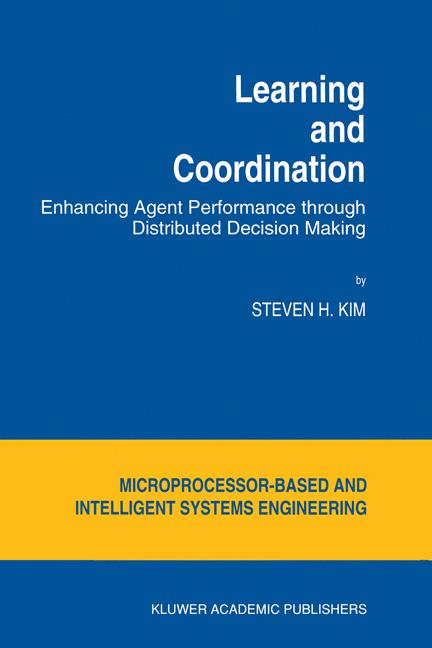
Intelligent systems of the natural kind are adaptive and robust: they learn over time and degrade gracefully under stress. If artificial systems are to display a similar level of sophistication, an organizing framework and operating principles are required to manage the resulting complexity of design and behavior. This book presents a general framework for adaptive systems. The utility of the comprehensive framework is demonstrated by tailoring it to particular models of computational learning, ranging from neural networks to declarative logic. The key to robustness lies in distributed decision making. An exemplar of this strategy is the neural network in both its biological and synthetic forms. In a neural network, the knowledge is encoded in the collection of cells and their linkages, rather than in any single component. Distributed decision making is even more apparent in the case of independent agents. For a population of autonomous agents, their proper coordination may well be more instrumental for attaining their objectives than are their individual capabilities. This book probes the problems and opportunities arising from autonomous agents acting individually and collectively. Following the general framework for learning systems and its application to neural networks, the coordination of independent agents through game theory is explored. Finally, the utility of game theory for artificial agents is revealed through a case study in robotic coordination. Given the universality of the subjects -- learning behavior and coordinative strategies in uncertain environments -- this book will be of interest to students and researchers in various disciplines, ranging from all areas of engineering to the computing disciplines; from the life sciences to the physical sciences; and from the management arts to social studies.
Similar products
 50 Years of Philosophy and Medicine
from $107.30
50 Years of Philosophy and Medicine
from $107.30
 Understanding Cybersecurity Law and Digital Privacy
from $122.63
Understanding Cybersecurity Law and Digital Privacy
from $122.63
 Decisions in International Trade and Logistics
from $122.63
Decisions in International Trade and Logistics
from $122.63
 Advances in Economic Measurement
from $122.63
Advances in Economic Measurement
from $122.63
 Nanomaterials
from $137.96
Nanomaterials
from $137.96
 Sustainable Scaffolds-based Strategies in Tissue Engineering and Regenerative Medicine
from $162.87
Sustainable Scaffolds-based Strategies in Tissue Engineering and Regenerative Medicine
from $162.87
 Narratives in Educational Research
from $162.87
Narratives in Educational Research
from $162.87
 Environmental Biology of the Young Chinese Sturgeon
from $210.78
Environmental Biology of the Young Chinese Sturgeon
from $210.78