
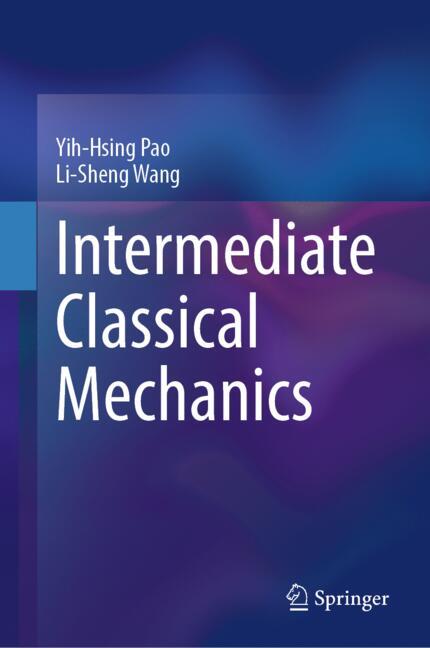
Intermediate Classical Mechanics
☆☆☆☆☆
(0 reviews)
Lowest price (incl. delivery)
9 180,00 JPY
Typical price1 579,96 PLN
Lowest (90 days)55,99 PLN
Offers3
Last updated1주 전
Price history (90 days)
Full history
2026-08-08
2026-08-15
| 업데이트 일시 | 가격 |
|---|---|
| 2026-08-08 | 55,99 |
| 2026-08-15 | 55,99 |
| 판매자 | Product price | Delivery | 합계 | 재고 여부 | Updated | |
|---|---|---|---|---|---|---|
| SP SpringerNatureLink Shop INT | 9 151,00 JPY | 29,00 JPY | 9 180,00 JPY | 구매 가능 | 6일 전 | View offer |
| SP Springer Nature Author | 9 151,00 JPY | 19,00 JPY | 9 170,00 JPY | 구매 가능 | 1주 전 | View offer |
| SP SpringerNatureLink Shop INT | 75,50 EUR | 29,00 EUR | 104,50 EUR | 구매 가능 | 6일 전 | View offer |
가격과 재고 여부는 변경될 수 있습니다. 마지막 업데이트: 08.08.2026 23:18.
EAN
9789819791361
Springer Nature
0,0
☆☆☆☆☆
0 reviews
5★
0%
4★
0%
3★
0%
2★
0%
1★
0%
Product reviews
No reviews yet — be the first!
This book describes the basic concepts and principles of classical mechanics in the intermediate level. Given the perspective that different mechanical problems require an appropriate approach drawn from various methods or principles, a textbook discussing multiple methods or principles in mechanics is highly desirable. Additionally, a good textbook should include historical context on the motivation and the development of the methods or principles, allowing students to gain insights that may help them discover new theories. However, after many years of teaching Dynamics in the graduate school, the authors were unable to find a suitable intermediate-level textbook on classical mechanics, which motivated them to begin writing this book. For the aforementioned reasons, this book includes the descriptions of various methods or principles in mechanics, such as the Newton-Euler Principle, the d’Alembert Principle, Lagrangian methods, Gauss’s Principle of Least Constraint, the Gibbs-Appell equation, Jourdain’s equation, the Principle of Virtual Power, the Appell-Kane method, the Hamilton Principle, and the Hamiltonian mechanics, among others. Moreover, many historical remarks on the motivation and the development of the methods or principles are given in this book, as well as numerous applications. The authors also believe that in studying the motion of a material body, different models may be used depending on the application. If the position of the body is of interest, a particle model may be chosen. If the orientation or attitude of the body is under consideration, a rigid body model should be adopted. If deformation is a concern, a model of deformable body should be applied. Consequently, a book in mechanics for engineers should encompass a variety of models of the body, ranging from particles to continua such as solids or fluids. This book also meets that need.
Similar products
 50 Years of Philosophy and Medicine
from $107.30
50 Years of Philosophy and Medicine
from $107.30
 Understanding Cybersecurity Law and Digital Privacy
from $122.63
Understanding Cybersecurity Law and Digital Privacy
from $122.63
 Decisions in International Trade and Logistics
from $122.63
Decisions in International Trade and Logistics
from $122.63
 Advances in Economic Measurement
from $122.63
Advances in Economic Measurement
from $122.63
 Nanomaterials
from $137.96
Nanomaterials
from $137.96
 Sustainable Scaffolds-based Strategies in Tissue Engineering and Regenerative Medicine
from $162.87
Sustainable Scaffolds-based Strategies in Tissue Engineering and Regenerative Medicine
from $162.87
 Narratives in Educational Research
from $162.87
Narratives in Educational Research
from $162.87
 Environmental Biology of the Young Chinese Sturgeon
from $210.78
Environmental Biology of the Young Chinese Sturgeon
from $210.78