
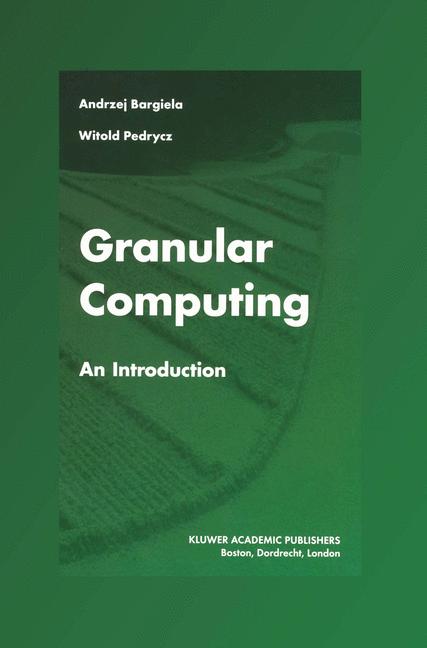
Granular Computing
☆☆☆☆☆
(0 reviews)
Lowest price (incl. delivery)
28 614,00 JPY
Typical price3 868,10 PLN
Lowest (90 days)129,99 PLN
Offers1
Last updated2일 전
| 판매자 | Product price | Delivery | 합계 | 재고 여부 | Updated | |
|---|---|---|---|---|---|---|
| SP Springer Nature Author | 28 599,00 JPY | 15,00 JPY | 28 614,00 JPY | 구매 가능 | 2일 전 | View offer |
가격과 재고 여부는 변경될 수 있습니다. 마지막 업데이트: 08.08.2026 23:35.
0,0
☆☆☆☆☆
0 reviews
5★
0%
4★
0%
3★
0%
2★
0%
1★
0%
Product reviews
No reviews yet — be the first!
This book is about Granular Computing (GC) - an emerging conceptual and of information processing. As the name suggests, GC concerns computing paradigm processing of complex information entities - information granules. In essence, information granules arise in the process of abstraction of data and derivation of knowledge from information. Information granules are everywhere. We commonly use granules of time (seconds, months, years). We granulate images; millions of pixels manipulated individually by computers appear to us as granules representing physical objects. In natural language, we operate on the basis of word-granules that become crucial entities used to realize interaction and communication between humans. Intuitively, we sense that information granules are at the heart of all our perceptual activities. In the past, several formal frameworks and tools, geared for processing specific information granules, have been proposed. Interval analysis, rough sets, fuzzy sets have all played important role in knowledge representation and processing. Subsequently, information granulation and information granules arose in numerous application domains. Well-known ideas of rule-based systems dwell inherently on information granules. Qualitative modeling, being one of the leading threads of AI, operates on a level of information granules. Multi-tier architectures and hierarchical systems (such as those encountered in control engineering), planning and scheduling systems all exploit information granularity. We also utilize information granules when it comes to functionality granulation, reusability of information and efficient ways of developing underlying information infrastructures.
Similar products
 Gamma Knife Neurosurgery in the Management of Intracranial Disorders
from $210.78
Gamma Knife Neurosurgery in the Management of Intracranial Disorders
from $210.78
 SDGs in Construction Economics and Organization
from $210.78
SDGs in Construction Economics and Organization
from $210.78
 Emerging Therapies in Neurorehabilitation III
from $210.78
Emerging Therapies in Neurorehabilitation III
from $210.78
 Ground Improvement Techniques
from $220.36
Ground Improvement Techniques
from $220.36
 Anomaly Detection in Video Surveillance
from $220.36
Anomaly Detection in Video Surveillance
from $220.36
 Mechanism and Machine Science
from $287.42
Mechanism and Machine Science
from $287.42
 Protein-Protein Interactions as New Drug Targets
from $287.42
Protein-Protein Interactions as New Drug Targets
from $287.42
 Proceedings of the 7th International Conference of Transportation Research Group of India (CTRG 2023
from $287.42
Proceedings of the 7th International Conference of Transportation Research Group of India (CTRG 2023
from $287.42