
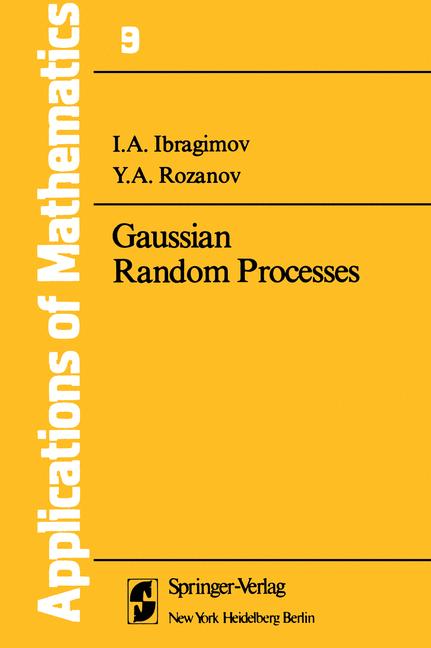
Gaussian Random Processes
☆☆☆☆☆
(0 reviews)
Lowest price (incl. delivery)
17 178,00 JPY
Typical price714,62 PLN
Lowest (90 days)44,99 PLN
Offers6
Last updated1주 전
Price history (90 days)
Full history
2026-08-08
2026-08-15
| 업데이트 일시 | 가격 |
|---|---|
| 2026-08-08 | 49,99 |
| 2026-08-14 | 44,99 |
| 2026-08-15 | 51,99 |
| 판매자 | Product price | Delivery | 합계 | 재고 여부 | Updated | |
|---|---|---|---|---|---|---|
| SP SpringerNatureLink Shop INT | 17 159,00 JPY | 19,00 JPY | 17 178,00 JPY | 구매 가능 | 1일 전 | View offer |
| SP Springer Nature Author | 17 159,00 JPY | free | 17 159,00 JPY | 구매 가능 | 1주 전 | View offer |
| SP SpringerNatureLink Shop INT | 119,99 USD | 15,00 USD | 134,99 USD | 구매 가능 | 2일 전 | View offer |
| SP SpringerNatureLink Shop INT | 129,99 USD | 29,00 USD | 158,99 USD | 구매 가능 | 2일 전 | View offer |
| SP SpringerNatureLink Shop INT | 129,99 USD | 15,00 USD | 144,99 USD | 구매 가능 | 2일 전 | View offer |
| SP SpringerNatureLink Shop INT | 142,00 EUR | 15,00 EUR | 157,00 EUR | 구매 가능 | 2일 전 | View offer |
가격과 재고 여부는 변경될 수 있습니다. 마지막 업데이트: 08.08.2026 23:12.
0,0
☆☆☆☆☆
0 reviews
5★
0%
4★
0%
3★
0%
2★
0%
1★
0%
Product reviews
No reviews yet — be the first!
The book deals mainly with three problems involving Gaussian stationary processes. The first problem consists of clarifying the conditions for mutual absolute continuity (equivalence) of probability distributions of a "random process segment" and of finding effective formulas for densities of the equiva lent distributions. Our second problem is to describe the classes of spectral measures corresponding in some sense to regular stationary processes (in par ticular, satisfying the well-known "strong mixing condition") as well as to describe the subclasses associated with "mixing rate". The third problem involves estimation of an unknown mean value of a random process, this random process being stationary except for its mean, i. e. , it is the problem of "distinguishing a signal from stationary noise". Furthermore, we give here auxiliary information (on distributions in Hilbert spaces, properties of sam ple functions, theorems on functions of a complex variable, etc. ). Since 1958 many mathematicians have studied the problem of equivalence of various infinite-dimensional Gaussian distributions (detailed and sys tematic presentation of the basic results can be found, for instance, in [23]). In this book we have considered Gaussian stationary processes and arrived, we believe, at rather definite solutions. The second problem mentioned above is closely related with problems involving ergodic theory of Gaussian dynamic systems as well as prediction theory of stationary processes.
Similar products
 50 Years of Philosophy and Medicine
from $107.30
50 Years of Philosophy and Medicine
from $107.30
 Understanding Cybersecurity Law and Digital Privacy
from $122.63
Understanding Cybersecurity Law and Digital Privacy
from $122.63
 Decisions in International Trade and Logistics
from $122.63
Decisions in International Trade and Logistics
from $122.63
 Advances in Economic Measurement
from $122.63
Advances in Economic Measurement
from $122.63
 Nanomaterials
from $137.96
Nanomaterials
from $137.96
 Sustainable Scaffolds-based Strategies in Tissue Engineering and Regenerative Medicine
from $162.87
Sustainable Scaffolds-based Strategies in Tissue Engineering and Regenerative Medicine
from $162.87
 Narratives in Educational Research
from $162.87
Narratives in Educational Research
from $162.87
 Environmental Biology of the Young Chinese Sturgeon
from $210.78
Environmental Biology of the Young Chinese Sturgeon
from $210.78