
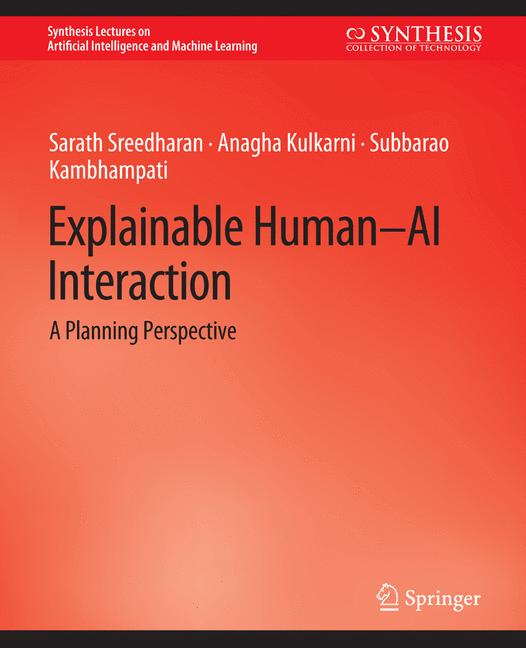
Explainable Human-AI Interaction
☆☆☆☆☆
(0 reviews)
Lowest price (incl. delivery)
54,99 USD
Typical price51,14 PLN
Lowest (90 days)39,99 PLN
Offers6
Last updated1주 전
Price history (90 days)
Full history
2026-08-08
2026-08-15
| 업데이트 일시 | 가격 |
|---|---|
| 2026-08-08 | 44,99 |
| 2026-08-14 | 39,99 |
| 2026-08-15 | 52,00 |
| 판매자 | Product price | Delivery | 합계 | 재고 여부 | Updated | |
|---|---|---|---|---|---|---|
| SP SpringerNatureLink Shop INT | 54,99 USD | free | 54,99 USD | 구매 가능 | 5일 전 | View offer |
| SP SpringerNatureLink Shop INT | 54,99 USD | 19,00 USD | 73,99 USD | 구매 가능 | 5일 전 | View offer |
| SP SpringerNatureLink Shop INT | 59,99 USD | free | 59,99 USD | 구매 가능 | 5일 전 | View offer |
| SP SpringerNatureLink Shop INT | 59,99 USD | free | 59,99 USD | 구매 가능 | 5일 전 | View offer |
| SP Springer Nature Author | 59,99 USD | 25,00 USD | 84,99 USD | 구매 가능 | 1주 전 | View offer |
| SP SpringerNatureLink Shop INT | 58,84 EUR | 19,00 EUR | 77,84 EUR | 구매 가능 | 5일 전 | View offer |
가격과 재고 여부는 변경될 수 있습니다. 마지막 업데이트: 08.08.2026 11:15.
0,0
☆☆☆☆☆
0 reviews
5★
0%
4★
0%
3★
0%
2★
0%
1★
0%
Product reviews
No reviews yet — be the first!
From its inception, artificial intelligence (AI) has had a rather ambivalent relationship with humans—swinging between their augmentation and replacement. Now, as AI technologies enter our everyday lives at an ever-increasing pace, there is a greater need for AI systems to work synergistically with humans. One critical requirement for such synergistic human‒AI interaction is that the AI systems' behavior be explainable to the humans in the loop. To do this effectively, AI agents need to go beyond planning with their own models of the world, and take into account the mental model of the human in the loop. At a minimum, AI agents need approximations of the human's task and goal models, as well as the human's model of the AI agent's task and goal models. The former will guide the agent to anticipate and manage the needs, desires and attention of the humans in the loop, and the latter allow it to act in ways that are interpretable to humans (by conforming to their mental models of it), andbe ready to provide customized explanations when needed. The authors draw from several years of research in their lab to discuss how an AI agent can use these mental models to either conform to human expectations or change those expectations through explanatory communication. While the focus of the book is on cooperative scenarios, it also covers how the same mental models can be used for obfuscation and deception. The book also describes several real-world application systems for collaborative decision-making that are based on the framework and techniques developed here. Although primarily driven by the authors' own research in these areas, every chapter will provide ample connections to relevant research from the wider literature. The technical topics covered in the book are self-contained and are accessible to readers with a basic background in AI.
Similar products
 50 Years of Philosophy and Medicine
from $107.30
50 Years of Philosophy and Medicine
from $107.30
 Understanding Cybersecurity Law and Digital Privacy
from $122.63
Understanding Cybersecurity Law and Digital Privacy
from $122.63
 Decisions in International Trade and Logistics
from $122.63
Decisions in International Trade and Logistics
from $122.63
 Advances in Economic Measurement
from $122.63
Advances in Economic Measurement
from $122.63
 Nanomaterials
from $137.96
Nanomaterials
from $137.96
 Sustainable Scaffolds-based Strategies in Tissue Engineering and Regenerative Medicine
from $162.87
Sustainable Scaffolds-based Strategies in Tissue Engineering and Regenerative Medicine
from $162.87
 Narratives in Educational Research
from $162.87
Narratives in Educational Research
from $162.87
 Environmental Biology of the Young Chinese Sturgeon
from $210.78
Environmental Biology of the Young Chinese Sturgeon
from $210.78