
Engineering Elasticity
☆☆☆☆☆
(0 reviews)
Lowest price (incl. delivery)
50,28 USD
Typical price61,71 PLN
Lowest (90 days)43,99 PLN
Offers7
Last updated1주 전
Price history (90 days)
Full history
2026-08-08
2026-08-15
| 업데이트 일시 | 가격 |
|---|---|
| 2026-08-08 | 49,99 |
| 2026-08-14 | 43,99 |
| 2026-08-15 | 54,99 |
| 판매자 | Product price | Delivery | 합계 | 재고 여부 | Updated | |
|---|---|---|---|---|---|---|
| SP SpringerNatureLink Shop INT | 50,28 USD | free | 50,28 USD | 구매 가능 | 5일 전 | View offer |
| SP SpringerNatureLink Shop INT | 84,99 USD | free | 84,99 USD | 구매 가능 | 4일 전 | View offer |
| SP SpringerNatureLink Shop INT | 84,99 USD | free | 84,99 USD | 구매 가능 | 4일 전 | View offer |
| SP SpringerNatureLink Shop INT | 74,99 GBP | 25,00 GBP | 99,99 GBP | 구매 가능 | 4일 전 | View offer |
| SP SpringerNatureLink Shop INT | 99,99 USD | free | 99,99 USD | 구매 가능 | 4일 전 | View offer |
| SP SpringerNatureLink Shop INT | 99,99 USD | 29,00 USD | 128,99 USD | 구매 가능 | 4일 전 | View offer |
| SP Springer Nature Author | 99,99 USD | 19,00 USD | 118,99 USD | 구매 가능 | 1주 전 | View offer |
가격과 재고 여부는 변경될 수 있습니다. 마지막 업데이트: 08.08.2026 13:37.
0,0
☆☆☆☆☆
0 reviews
5★
0%
4★
0%
3★
0%
2★
0%
1★
0%
Product reviews
No reviews yet — be the first!
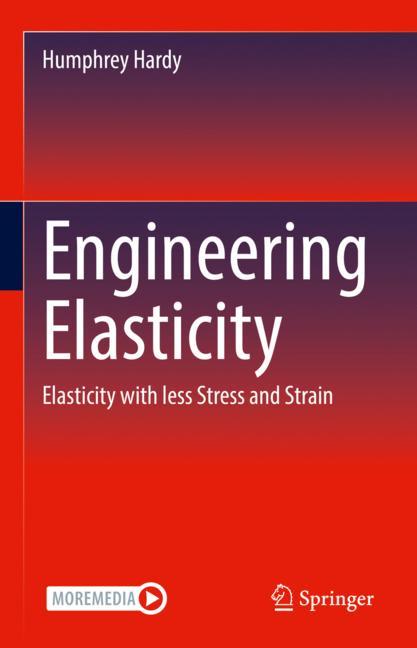
This textbook aimed at upper-level undergraduate and graduate engineering students who need to describe the large deformation of elastic materials like soft plastics, rubber, and biological materials. The classical approaches to finite deformations of elastic materials describe a dozen or more measures of stress and strain. These classical approaches require an in-depth knowledge of tensor analysis and provide little instruction as to how to relate the derived equations to the materials to be described. This text, by contrast, introduces only one strain measure and one stress measure. No tensor analysis is required. The theory is applied by showing how to measure material properties and to perform computer simulations for both isotropic and anisotropic materials. The theory can be covered in one chapter for students familiar with Euler-Lagrange techniques, but is also introduced more slowly in several chapters for students not familiar with these techniques. The connection to linear elasticity is provided along with a comparison of this approach to classical elasticity.
Similar products
 50 Years of Philosophy and Medicine
from $107.30
50 Years of Philosophy and Medicine
from $107.30
 Understanding Cybersecurity Law and Digital Privacy
from $122.63
Understanding Cybersecurity Law and Digital Privacy
from $122.63
 Decisions in International Trade and Logistics
from $122.63
Decisions in International Trade and Logistics
from $122.63
 Advances in Economic Measurement
from $122.63
Advances in Economic Measurement
from $122.63
 Nanomaterials
from $137.96
Nanomaterials
from $137.96
 Sustainable Scaffolds-based Strategies in Tissue Engineering and Regenerative Medicine
from $162.87
Sustainable Scaffolds-based Strategies in Tissue Engineering and Regenerative Medicine
from $162.87
 Narratives in Educational Research
from $162.87
Narratives in Educational Research
from $162.87
 Environmental Biology of the Young Chinese Sturgeon
from $210.78
Environmental Biology of the Young Chinese Sturgeon
from $210.78