
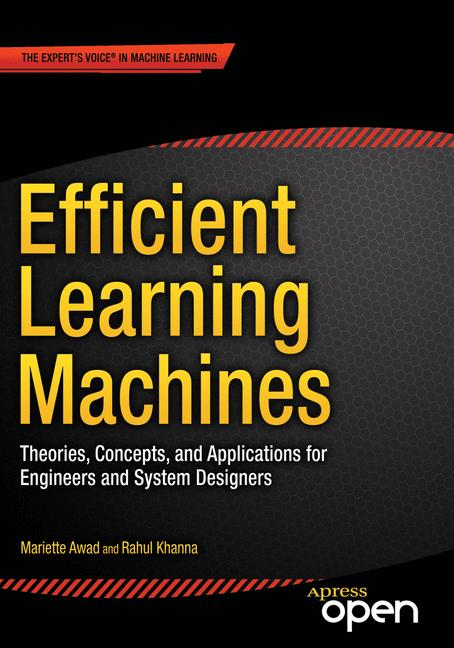
Efficient Learning Machines
☆☆☆☆☆
(0 reviews)
Lowest price (incl. delivery)
28,82 EUR
Typical price165,70 PLN
Lowest (90 days)6,92 PLN
Offers3
Last updated4일 전
Price history (90 days)
Full history
2026-08-07
2026-08-08
| 업데이트 일시 | 가격 |
|---|---|
| 2026-08-07 | 6,92 |
| 2026-08-08 | 28,82 |
| 판매자 | Product price | Delivery | 합계 | 재고 여부 | Updated | |
|---|---|---|---|---|---|---|
| VI VitalSource | 28,82 EUR | free | 28,82 EUR | 구매 가능 | 4일 전 | View offer |
| SP Springer Nature Author | 5 433,00 JPY | free | 5 433,00 JPY | 구매 가능 | 3일 전 | View offer |
| SP SpringerNatureLink Shop INT | 45,00 EUR | free | 45,00 EUR | 구매 가능 | 4일 전 | View offer |
가격과 재고 여부는 변경될 수 있습니다. 마지막 업데이트: 08.08.2026 09:03.
EAN
9781430259893
Springer Nature
0,0
☆☆☆☆☆
0 reviews
5★
0%
4★
0%
3★
0%
2★
0%
1★
0%
Product reviews
No reviews yet — be the first!
Machine learning techniques provide cost-effective alternatives to traditional methods for extracting underlying relationships between information and data and for predicting future events by processing existing information to train models. Efficient Learning Machines explores the major topics of machine learning, including knowledge discovery, classifications, genetic algorithms, neural networking, kernel methods, and biologically-inspired techniques. Mariette Awad and Rahul Khanna’s synthetic approach weaves together the theoretical exposition, design principles, and practical applications of efficient machine learning. Their experiential emphasis, expressed in their close analysis of sample algorithms throughout the book, aims to equip engineers, students of engineering, and system designers to design and create new and more efficient machine learning systems. Readers of Efficient Learning Machines will learn how to recognize and analyze the problems that machine learning technology can solve for them, how to implement and deploy standard solutions to sample problems, and how to design new systems and solutions. Advances in computing performance, storage, memory, unstructured information retrieval, and cloud computing have coevolved with a new generation of machine learning paradigms and big data analytics, which the authors present in the conceptual context of their traditional precursors. Awad and Khanna explore current developments in the deep learning techniques of deep neural networks, hierarchical temporal memory, and cortical algorithms. Nature suggests sophisticated learning techniques that deploy simple rules to generate highly intelligent and organized behaviors with adaptive, evolutionary, and distributed properties. The authors examine the most popular biologically-inspired algorithms, together with a sample application to distributed datacenter management. They also discuss machine learning techniques for addressing problems of multi-objective optimization in which solutions in real-world systems are constrained and evaluated based on how well they perform with respect to multiple objectives in aggregate. Two chapters on support vector machines and their extensions focus on recent improvements to the classification and regression techniques at the core of machine learning.