
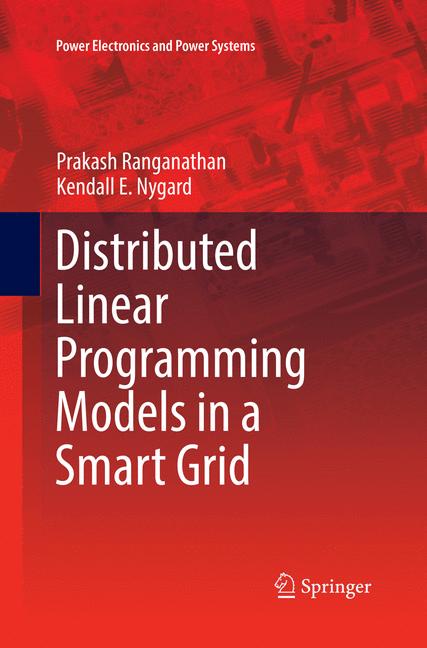
Distributed Linear Programming Models in a Smart Grid
☆☆☆☆☆
(0 reviews)
Lowest price (incl. delivery)
18 608,00 JPY
Typical price2 011,11 PLN
Lowest (90 days)87,50 PLN
Offers2
Last updated1일 전
| 판매자 | Product price | Delivery | 합계 | 재고 여부 | Updated | |
|---|---|---|---|---|---|---|
| SP Springer Nature Author | 18 589,00 JPY | 19,00 JPY | 18 608,00 JPY | 구매 가능 | 1일 전 | View offer |
| SP SpringerNatureLink Shop INT | 109,99 GBP | free | 109,99 GBP | 구매 가능 | 1일 전 | View offer |
가격과 재고 여부는 변경될 수 있습니다. 마지막 업데이트: 08.08.2026 22:23.
0,0
☆☆☆☆☆
0 reviews
5★
0%
4★
0%
3★
0%
2★
0%
1★
0%
Product reviews
No reviews yet — be the first!
This book showcases the strengths of Linear Programming models for Cyber Physical Systems (CPS), such as the Smart Grids. Cyber-Physical Systems (CPS) consist of computational components interconnected by computer networks that monitor and control switched physical entities interconnected by physical infrastructures. A fundamental challenge in the design and analysis of CPS is the lack of understanding in formulating constraints for complex networks. We address this challenge by employing collection of Linear programming solvers that models the constraints of sub-systems and micro grids in a distributed fashion. The book can be treated as a useful resource to adaptively schedule resource transfers between nodes in a smart power grid. In addition, the feasibility conditions and constraints outlined in the book will enable in reaching optimal values that can help maintain the stability of both the computer network and the physical systems. It details the collection of optimization methods that are reliable for electric-utilities to use for resource scheduling, and optimizing their existing systems or sub-systems. The authors answer to key questions on ways to optimally allocate resources during outages, and contingency cases (e.g., line failures, and/or circuit breaker failures), how to design de-centralized methods for carrying out tasks using decomposition models; and how to quantify un-certainty and make decisions in the event of grid failures.
Similar products
 Patient Safety Coaching
from $91.97
Patient Safety Coaching
from $91.97
 Ethnography and Diversity
from $69.30
Ethnography and Diversity
from $69.30
 Smart Villages
from $91.97
Smart Villages
from $91.97
 Nuclear Non-Proliferation in International Law - Volume VI
from $91.97
Nuclear Non-Proliferation in International Law - Volume VI
from $91.97
 The Price of Freedom
from $91.97
The Price of Freedom
from $91.97
 Eco-Social Policy in the OECD and the World Bank
from $91.97
Eco-Social Policy in the OECD and the World Bank
from $91.97
 Special Topics in Policing
from $122.58
Special Topics in Policing
from $122.58
 Music from the Heart
from $91.97
Music from the Heart
from $91.97